Arguably, artificial intelligence and its evolving capacities for (moving) image generation, consistently raise questions about agency and animation. While responses to these developments oscillate between fears of job loss and enthusiastic embraces of new possibilities, underneath lies the question: What happens to the agency of animators when AI becomes central to animation production?
In these debates, agency—understood as the capacity to act and creatively express oneself—is framed in two contradictory but interdependent ways. On the one hand, AI seems to reduce human agency by replacing animators or restricting their creative opportunities (thus linking questions of artistic agency to financial agency within capitalist structures). On the other hand, AI is celebrated as a democratizing tool through which “anyone”[i] can “animate”. This democratization narrative is deeply tied to the promotional rhetoric of big tech, as Mihaela Mihailova (2023) has analyzed. However, it is productive to examine the underlying idea of “animation for everyone” to understand whether the current development of AI indeed marks an agentic shift beyond previous technological transformations.
Of course, technological involvement in creative expression is nothing new, especially to animation, which usually foregrounds the interplay between matter, tools, workflows, and animators (see e.g. Wells 2014). Thus, the crucial issue is not the existence of technological agency as such but its configuration: how tools operate, and which forms of action they enable or foreclose.
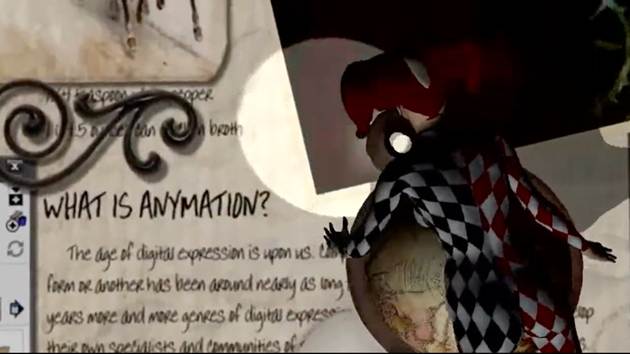
Fig. 1: Screenshot from Anymated Scrapbook, directed by Tom Jantol (2008).
To trace potential shifts in agency through AI, let me revisit a term and concept that circulated in the machinima community during the mid-2000s: anymation (see Fig. 1). Coined by machinimist and digital animator Tom Jantol, it means:
“If anybody, anywhere with anything can do it, it is Anymation.” (Jantol 2008b)
Jantol proposed the term to acknowledge the expansion of machinima production beyond the mere usage of game engines at that time. And interestingly, Jantol’s comments and writings somehow foreshadow current AI industry’s promises when he writes:
“Maybe, just maybe, these present times are the first period in animated movie history when any author really can make anything he wants. For the first time he can do that in real time. This merge of advanced technology and state of author’s mind deserves its own name.” (Jantol 2008a)
This could be a profound description of what has happened since the advent of openly accessible (nearly) real-time video GenAI, which specifically seems to challenge the “merge of advanced technology and state of author’s mind”.
Most traditional CGI genres, as Jantol argues in his Anymation Manifesto (Jantol n.d.)[ii], force creators to work within the constraints of a single tool or environment thus restricting creative agency by technological boundaries. In contrast, anymation seeks to free the idea from software limitations so that expression remains primary (see also Hartmann 2012, 120). In this framework, agency resides in the animator’s capacity to choose and combine tools. Technology may “act”, but its agency is subordinated to the artist. With regard to AI, this hierarchical framework is challenged insofar as “artificial intelligence” is often imagined as an agency that rivals human expressivity[iii], potentially becoming one of the agentic “anyones” of “anymation” itself.[iv]
Simultaneously, AI raises new questions about the functioning, mediality, and politics of tools. While anymators of the early 2000s usually interacted with visually mediated, manually operated software interfaces, GenAI replaces direct visual interaction with text-based or non–moving-image inputs. The shift from visual craft to linguistic prompting therefore seems to relocate human expression from the realm of manual manipulation to pure concept – as an advertisement clip of Google Gemini’s Veo states: “Video Starts with a Sentence” (see Fig. 2).
Fig. 2: Advertising Clip for Veo by Google Gemini (2025).
At the same time, GenAI introduces expanded and obscured forms of agency to the production process. Training datasets reproduce historical and societal biases and ignore copyrights; clickworkers shape outputs through their invisible exploited labor (while being restricted in their agency to speak about their work by non-disclosure agreements); corporate models dictate what AI can produce, etc. The outcomes are therefore shaped by a network of—more or less powerful—human and non-human actors behind the interface. While digital animation has never existed only between the artist and the software, AI seems to bring even more agents into the equation.
This opacity becomes troubling when considering Hito Steyerl’s diagnosis that AI produces fundamentally “Mean Images” (Steyerl 2023), reflecting exploitation and extractivism. Here, the democratization narrative collapses: what appears as empowerment relies on hidden forms of economic and epistemic violence. Scholars such as Roland Meyer (2025) even highlight a proximity between GenAI aesthetics and anti-democratic and fascist tendencies produced by these mechanisms—through automation of cultural production, a neglect of artistic individuality, and a logic of reactionary nostalgia.
In short: what seems democratizing may be centralizing, privatizing, and constraining collective imagination. But what can we do about it? For animation—a medium historically attentive to distributed agency—the task is to develop agentic structures within a landscape of heterogenous sociotechnical actors. In the end, what we need are ideas of an alternative AI—or ALAI: an ally rather than an auteur, supporting creativity without subsuming or obscuring agencies. In this sense, the “any” in anymation could mean to eventually find fair ways of distributing agency to the artist, the technology, and the broader human and non-human networks in which they operate.
Endnotes
[i] This raises the critical question of who is actually included in this „anyone” and who is excluded because of having no access to these technologies.
[ii] Major parts of this manifesto are used as well in a film called Anymated Scrapbook (2008) that Jantol produced for the Machinima Expo in 2008 and that can be found here: http://vimeo.com/1990624 (see Fig. 1 for a screenshot). The details regarding the video and the manifesto are not consistent; while the manifesto text, that can still be found via the Internet Archive (Jantol n.d.), is signed with “Tom Jantol”, in the end credits of the video it says “text by Phil Rice”.
[iii] But if we believe Mihaela Mihailova’s thesis, this fear is unfounded, as “human creative decision-making cannot be automated,” and AI “can’t put the anima in animation” (Mihailova 2024).
[iv] One example to illustrate this idea of machines as expressive actors is the term agentic AI, which carries the agency in its name already, even though it is still largely aspirational.
References
Anymated Scrapbook (2009, Tom Jantol). https://www.youtube.com/watch?v=WVHhDROtyNc.
Hartmann, Doreen (2012). Machinima revisited. Über neue Praktiken und alte Ideale. In: Frisch, Simon; Raupach, Tim (eds.): Revisionen – Relektüren – Perspektiven. Marburg: Schüren, pp. 113–125. DOI: https://doi.org/10.25969/mediarep/14571.
Jantol (n.d.). Anymation Manifesto. https://web.archive.org/web/20120119025515/http://www.rockcanrollrecords.com/AnymationManifesto.pdf
Jantol, Tom (2008a). Commentary under the article “Anyone for Anymation”. Antics 3d, May 15, 2008. https://antics3d.wordpress.com/2008/05/15/anyone-for-anymation/.
Jantol, Tom (2008b). Anymation. Urban Dictionary, December 30, 2008. https://www.urbandictionary.com/define.php?term=anymation.
Meyer, Roland (2025). Echte Emotionen. Generative KI und rechte Weltbilder. Geschichte der Gegenwart, February 2, 2025. https://geschichtedergegenwart.ch/echte-emotionen-generative-ki-und-rechte-weltbilder/.
Mihailova, Mihaela (2023). Automated Animation: Where Craft Goes to AI. Film Quarterly, April 5, 2023. https://filmquarterly.org/2023/04/05/automated-animation-where-craft-goes-to-ai/.
Mihailova, Mihaela (2024). Ships in a Coffee Cup, Tempest in a Teapot. Animationstudies 2.0, June 11, 2024. https://blog.animationstudies.org/ships-in-a-coffee-cup-tempest-in-a-teapot/.
Steyerl, Hito (2023). Mean Images. New Left Review 140/141.
Wells, Paul (2014). Chairy Tales: Object and Materiality in Animation. alphaville. Journal of Film and Screen Media 8 (Winter 2014), pp. 1–18.
Jun. Prof. Dr. Julia Eckel is Junior Professor for Film Studies at the Department of Media Studies at Paderborn University. Her current research focuses on the relation between animation, documentation, and demonstration and on animation and AI; further interests include audiovisual anthropomorphism, synthespians, screencasting, tech-demos, and selfies. She is one of the speakers of AG Animation (a working group for animation scholars in german-speaking countries) and was a member of the DFG network “Animation and Contemporary Media Culture” from 2020 to 2024. In 2022, she guest-edited the animationstudies 2.0-Blog-Theme on Animation and AI together with Nea Ehrlich. More Info: www.juliaeckel.de.