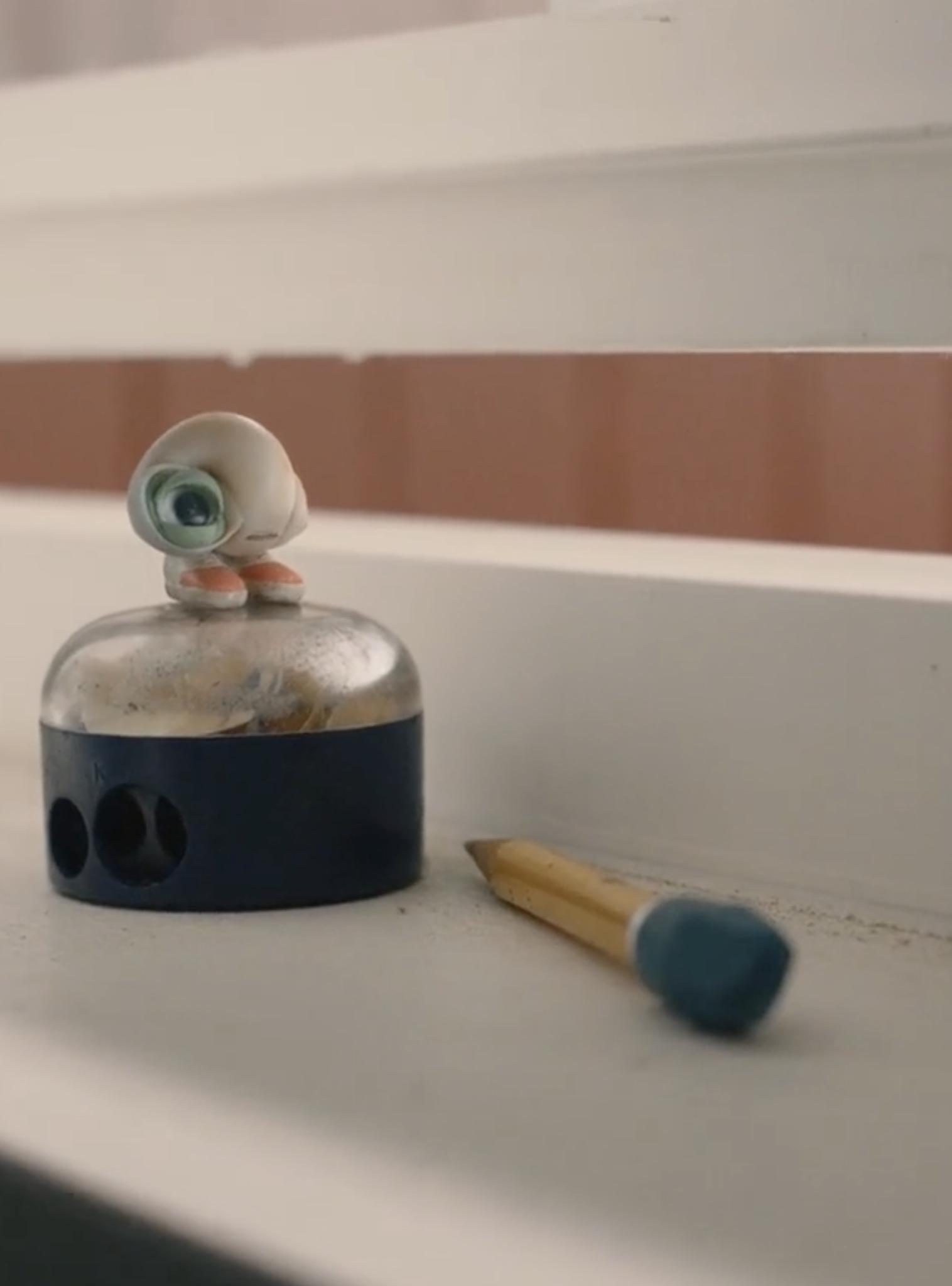
When an object in a film appears to be alive by virtue of its movements, this impression is most often produced through animation. Frame-by-frame animation is usually applied for this purpose—especially in live-action films. The animation of inanimate objects thus becomes emblematic of cinematic animation itself. This is evidenced by the fact that the Pixar Studios’ mascot, Luxo Jr. lamp, appears in all of the studio’s opening titles, bouncing confidently toward the ‘I’ in Pixar in the studio logo, squishing the letter before turning its glowing lampshade for a “head” toward the viewers in anticipation. The singing and dancing household items in Beauty and the Beast (1991), the rebellious chair in Norman McLaren’s A Chairy Tale (1957) or more recently the creature consisting of a shell, tiny shoes, and a single googly eye in Marcel the Shell with Shoes On (2021) are just some iconic examples of how objects and their autonomy or agency have a special relationship to cinematic animation (see Fig. 1). In this text, I examine this connection, claiming that animation extends and displays agency as part of the “sentience” of objects as acting characters and, more fundamentally, that animation negotiates in practice human and material agency as artistic intentions and material influences.
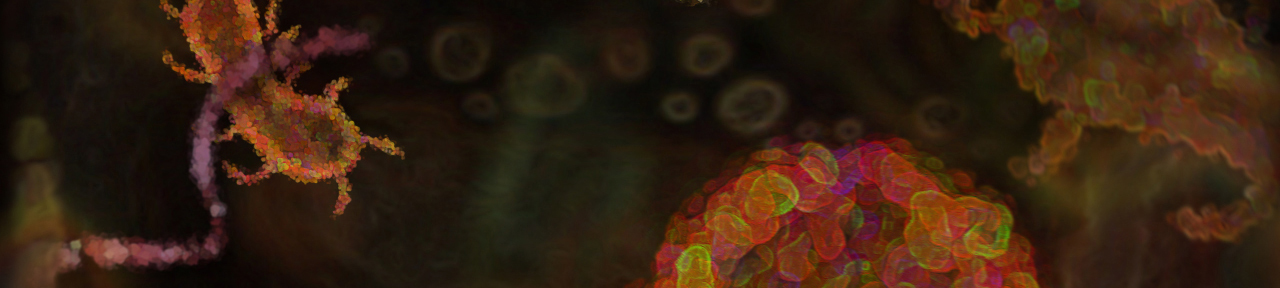
Etymologically derived from the Latin anima, meaning breath, soul, or spirit, animation is often defined as bringing immobile matter to life by setting it in motion. However, reducing animation to a mere mechanical illusion of life[1] is inadequate. Animation scholars such as Alan Cholodenko (2004) and Thomas Lamarre (2013) have suggested instead that dualisms—life/non-life, movement/stillness—should be challenged and that animated movement or life emerges within the cognitive activity of the viewer. Lamarre (2013, 127) opposes the widespread “illusion-of-life paradigm” with his idea that animated life originates in perception, further emphasising that animation offers an experience of vitality that does not simply compensate for stillness with an illusionary trick. Instead, viewers enter an animated world, engaging in a perceptual experiment. I expanded on Lamarre’s point in my PhD dissertation, arguing that animated life in this sense is qualitative, not absolute, and reveals itself only in and through a mode of mediated perceptual inquiry (Schamal 2024).
The life of formerly lifeless objects is especially convincingly depicted with animation. This is because, on the one hand, frame-by-frame techniques can transform anything imaginable into moving images. On the other hand, this is facilitated by the fact that animation evokes life in perception, producing a quality of aliveness that lends itself particularly well to objects. Animated film thus provides the preferred means for staging living objects cinematically, while also making them its preferred subject matter, as Tahei Imamura observed already in the 1930s: “Cartoon expression primarily favors the dynamism of the movement of ‘living’ objects. This is why it is not funny unless Mickey Mouse runs as fast as a bullet; Popeye’s fist hits like a bomb; we fly through the air on a bicycle and a toy horse transforms into a rocket; a beaver spins its tail like a motorboat to speed across the water; a bull chases a matador like a streamline electric train.” (Imamura 2010 [1936], 46).
Not only can animation portray objects as protagonists, but it enables the animation of actual physical objects. In stop-motion, anything —from crafted dolls to found objects—can be given cinematic movement. Animation scholar Paul Wells (2014, 6) describes a “privileged relationship” between objects and animation. Animation, according to him, can be seen as a kind of “suggesting or attaining motion in a seemingly static object. Self-evidently, the very engine of animation is to prescribe agency to objects” (Wells 2014, 2). The attribution and negotiation of agency is therefore crucial in animation practice. Wells establishes a connection between the animator’s handling of objects and the agency of the object itself. The animator’s labor cannot be reduced to working with a passive object (“acting upon”), but also involves acting with and acting through it, effectively treating it as an “actor” (Wells 2014, 7). His approach is generally consistent with the assumption of ‘material agency,’ which Van Oyen (2018, 1) suggests “entails the notion that material objects have an effect on the course of action that is irreducible to direct human intervention.” The manual processing of objects, Wells (2014) argues, affects the animator’s actions through its tactility.
Artists and material “exchange vital tactile information”, as archaeologist Lambros Malafouris (2008, 19) puts it, when he explains the reciprocity he observes between non-human and human factors in artistic production. He understands art creation as an act of collaboration between artist and material. Similarly, media scholar Olga Moskatova (2022) understands artistic practice as an act of co-production. Materials are not passive, they entail certain requirements, react to influences, and themselves influence the artist’s actions. She illustrates this using animation as an example, explaining further that the creation of animated film requires special embodied know-how, which often entails control of the entire body, as well as detailed knowledge of material properties, and practice in the use of various tools guiding the decisions and gestures of the filmmaker. The animator does for that reason not only animate the material, but the material itself animates, directs, and shapes the animator’s actions. The special connection between agency and animation arises from these negotiations—both on screen and in artistic practice—through which the unique impression of liveliness in animated film emerges.
[1] This notion, identified by Thomas Lamarre (2013) as a theoretical paradigm, is widely held in animation studies. It can be traced back, among other sources, to the seminal publication of the same name by Disney animators Frank Thomas and Ollie Johnston (1995) [1981].
References
A Chairy Tale (CA 1957, Norman McLaren).
Beauty and the Beast (US 1991, Gary Trousdale and Kirk Wise).
Cholodenko, Alan (2004). ‚First Principles‘ of Animation. In: Karen Beckman (ed.): Animating Film Theory. Durham, London: Duke University Press, pp. 98–110.
Imamura, Tahei. (2010 [1936]). A Theory of the Animated Sound Film. In: Review of Japanese Culture and Society 22, pp. 44–51.
Lamarre, Thomas. (2013). Coming to Life: Cartoon Animals and Natural Philosophy. In: Suzanne Buchan (ed.), Pervasive Animation. New York: Routledge, pp. 117–142.
Luxo Jr. (US 1986, John Lasseter).
Malafouris, Lambros (2008). At the Potter’s Wheel. An Argument for Material Agency. In: Lambros Malafouris, Carl Knappett (eds.), Material Agency. Towards a Non-anthropocentric Approach. New York: Springer, pp. 19-36.
Marcel the Shell with Shoes on (US 2021, Dean Fleischer Camp)
Moskatova, Olga (2022). Co-Production: Towards a Relational Ontogenesis of Media-Aesthetic Objects. In: Stephan Schmidt-Wulffen, German A. Duarte (eds.), The Object as Process. Bielefeld: transcript, pp. 85–100.
Oyen, Astrid Van (2018). Material Agency. In: Sandra L. López Varela (ed.), The Encyclopedia of Archaeological Sciences. Oxford: Wiley, pp. 1–5.
Schamal, Vera (2024). ‘Very Evidently in Motion’. Eine Begriffserweiterung des Animationsfilms anhand der Erforschungsgeschichte bewegter Materie. Zurich and Berlin: Diaphanes.
Thomas, Frank; Johnston, Ollie (1995 [1981]). The Illusion of Life. Disney Animation. New York: Disney Editions.
Wells, Paul (2014). Chairy Tales. Object and Materiality in Animation. In: Alphaville. On-Line Journal of Film and Screen Media 8, pp.. 1–18.
Vera Schamal is a postdoctoral research associate in the Research Focus Aesthetics at the Zurich University of the Arts, where she engages in the interdisciplinary research project (Material) Agency und Fehlversuche in der künstlerischen Praxis, which explores failure as a mode of artistic agency. She previously worked as a research assistant and lecturer at the Department of Film Studies at the University of Zurich, where she in 2022 completed her PhD dissertation on animation titled Very Evidently in Motion. Eine Begriffserweiterung des Animationsfilms anhand der Erforschungsgeschichte bewegter Materie. It presents an understanding of animation beyond the paradigm of illusion, drawing on historical scientific debates about vitality, observability, and knowability in relation to molecular reality.