
EXTENDED deadline: April 3, 2026
Guest editor: Dr. Ying Zhang
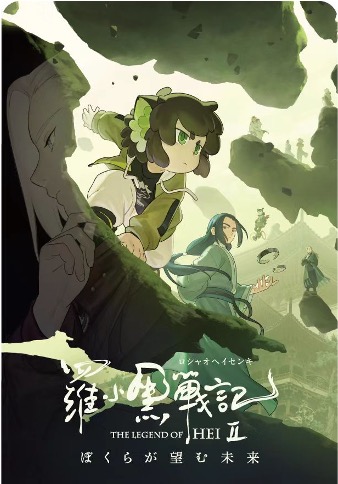
The visibility of animated features, such as the two installments of Ne Zha 1 (2019)and 2 (2023) and The Legend of Hei 1 (2019) and 2 (2025), highlights the vitality of contemporary Chinese animation. In recent years, the study of Chinese animation has expanded markedly, as reflected in a growing number of monographs and edited volumes published in international academic contexts. Works such as Chinese Animation: Multiplicities in Motion (ed. Daisy Yan Du, John A. Crespi, and Yiman Wang, 2025), Chinese Independent Animation: Renegotiating Identity in Modern China (Wenhai Zhou, 2021), and The History of Chinese Animation (Vols. I–II, ed. Lijun Sun, 2020) exemplify the diversity of current research agendas. This emerging scholarship signals the consolidation of Chinese animation as a distinct field within animation, film, and media studies, and demonstrates increasing scholarly interest in its historical depth, industrial structures, and cultural positioning.
The recent publications have approached Chinese animation from several key perspectives. Studies of industrial developmentexamine institutional reform, labor organization, and the incorporation of animation into broader creative industries. Research on the IP economyfocuses on franchising, platformization, and commercialization, while scholarship on nationalism and cultural identityexplores animation’s role in state discourse and soft power. In addition, work on technological innovation traces changes in production techniques, digital workflows, and systems of distribution. Together, these approaches have significantly enriched understandings of Chinese animation’s contemporary configurations and global circulation.
Despite the growing body of research on Chinese animation, there are still important gaps. Many studies focus on single themes, well-known works, or specific historical periods, but few examine how animation has developed across decades or connect different aspects of the field. Research on early and mid-twentieth-century animation often highlights individual creators or clear ideological messages, while broader questions, such as how animation interacts with cultural policies, educational programs, the structure of the animation industry, or international exchanges, have received less attention. These areas have not yet been studied in a way that combines multiple dimensions of historical periods, thematic focuses, and methodological approaches into a clear, connected perspective.
This theme invites contributions that explore Chinese animation from broad and connected perspectives, using historical, comparative, and interdisciplinary approaches. As well as encourage authors to consider how creators, studios, technologies, and social or political forces have shaped animation practices, and to situate Chinese animation in wider discussions of film, media, and global animation. Chinese animation is approached in its broadest and most diverse configurations. Topics may include, but are not limited to, the following:
- Historical trajectories of Chinese animation, early animation practices to contemporary feature films and serialized productions, with particular attention to state policy, cultural governance, and their impact across different historical periods.
- Nationalism, ideology, and cultural identity in Chinese animation, examined within shifting political, social, and cultural contexts.
- Chinese animation in comparative perspective, including dialogues, exchanges, and divergences with Japanese, American, European, and other Asian animation traditions.
- Technological change and aesthetic innovation in Chinese animation, encompassing digital production tools, hybrid media forms, and experimental or independent practices.
- Animation and adjacent creative industries in China, such as gaming, publishing, merchandising, theme parks, and digital content platforms.
- The political economy of Chinese animation, including industry structures, production and distribution models, and the roles of IP, capital investment, and platform economies.
- Animation education and professional training in China, including art academies, vocational institutions, independent training programs, and international exchange initiatives.
- Case studies of key animators, directors, studios, or representative works, addressing both historical and contemporary practices in Chinese animation.
We welcome submissions that meet the following criteria:
1. Between 700–1,000 words that clearly address the theme and present a coherent, well-structured argument.
2. Submissions should be sent as Microsoft Word files.
3. Include at least one image to visually support the argument/post.
3a. The image(s) must be less than 2 MB in size per image and sent as individual files.
3b. Please indicate where the image(s) should be placed in the text, including image caption(s) and credits.
3c. All permissions are the responsibility of the contributor.
4. A short author bio of no more than 100–120 words.
5. Include 3 keywords.
Please complete the submission form with all required information here: Submission Form.
For any inquiries, please contact Ying Zhang at zhangjingsan666[at]yahoo.co.jp, and kindly CC the co-editors Carmen Hannibal and Anastasiia Gushchina at blog[at]animationstudies.org.