The Legend of Hei (2019) did not begin as a stand-alone animated feature but emerged from The Legend of Luo Xiaohei (罗小黑战记), which is a web animation created by MTJJ that first aired in 2011. By the time the animation reached cinemas, the series had already built a substantial audience, as well as expanded beyond online distribution into theatrical and international circulation. Within this context, The Legend of Hei (2019) reads less as an isolated film than as part of a broader tendency in contemporary Chinese animation, in which web-based media move across formats, audiences, and exhibition contexts. That production history, however, is only the background. More revealing is the way the film negotiates questions of style and cultural specificity.
This becomes clearer when The Legend of Hei is set against earlier Chinese animation, especially works from Shanghai Animation Film Studio, where cultural specificity is conveyed directly through form from ink-painting aesthetics and related visual traditions (Du, 2019: 114–151). The distinctiveness of this formal style that set the benchmark for earlier works helps explain why questions of style, identity, and inheritance continue to shape scholarship on contemporary animation (Zhou, 2021: 4–5). This text argues that, although The Legend of Hei does not establish a strongly differentiated visual language of its own, its cultural specificity emerges more persuasively through its narrative structure, particularly in the way it organises conflict, judgment, and relation.
Surface Style and Formal Distinctiveness
Unlike the works of Shanghai Animation Film Studio, The Legend of Hei (2019) does not establish a strongly differentiated visual language of its own. Culturally specific elements are present, but they operate within a visual framework closer to the feature-animation idiom associated with Studio Ghibli than to one rooted in long-established visual traditions in China. A similar pattern can be seen in recent animated productions such as Big Fish & Begonia (大鱼海棠, 2016), White Snake (白蛇:缘起, 2019), and Green Snake (白蛇2:青蛇劫起, 2021), which retain recognisably Chinese elements, such as architecture, costume, colour symbolism, mythology, and movement inflected by martial-arts cinema, while also working through established international animation styles rather than developing a new formal language.
In The Legend of Hei (2019), the aforementioned elements are present, but they do not determine the animation’s visual logic in the way they do in the earlier Shanghai works. The film’s distinctiveness therefore lies less in the style of its surface than in the way meaning is organised at the level of its narrative structure.
Narrative Structure and Cultural Grounding
The animation’s distinctiveness lies less in the surface of style than in the way it organises conflict, judgment, and relation. Wang’s (2022) discussion of Big Fish & Begonia (2016) is helpful here, particularly for the way it made a distinction between visible cultural symbols and more structurally embedded forms of cultural expression. This can be seen in the central conflict between humans and spirits in the animation, which resists stable moral categories and simple hero-villain opposition. Humans are portrayed as destructive and short-sighted, yet not purely evil. Fengxi, the antagonist, uses coercion and violence, yet seeks to protect a world that human activity is erasing. Rather than polarised moral alignment, the animation presents competing views in which characters retain multiple and often conflicting dimensions.
One way of understanding this organisation of structure is through the concept of 天人合一 (tian ren he yi), which is often translated as the unity of heaven and humanity (Wang et al., 2022; Mok, 2020). Heaven in this context refers to a wider cosmic or natural order, and the concept foregrounds relation, balance, and coexistence rather than separation or domination (Mok, 2020: 148–150, 161–162). When considered in this way, the animation presents not a struggle between good and evil, but a breakdown in harmony between human expansion and the more-than-human world. The conflict remains ethically open rather than resolved.
The clearest example of this openness to the ethical appears near the end of the animation. Hei, the young spirit protagonist, asks whether Fengxi was good or bad, and Wuxian, his mentor and guardian, refuses to answer, leaving it open for Hei to make judgment. A second moment reinforces this pattern. After Fengxi becomes a forest, the suggestion that the forest may again be destroyed or absorbed into commerce undermines any sense of resolution. The conflict remains unsettled, and instead of restoring harmony the animation resists closure.
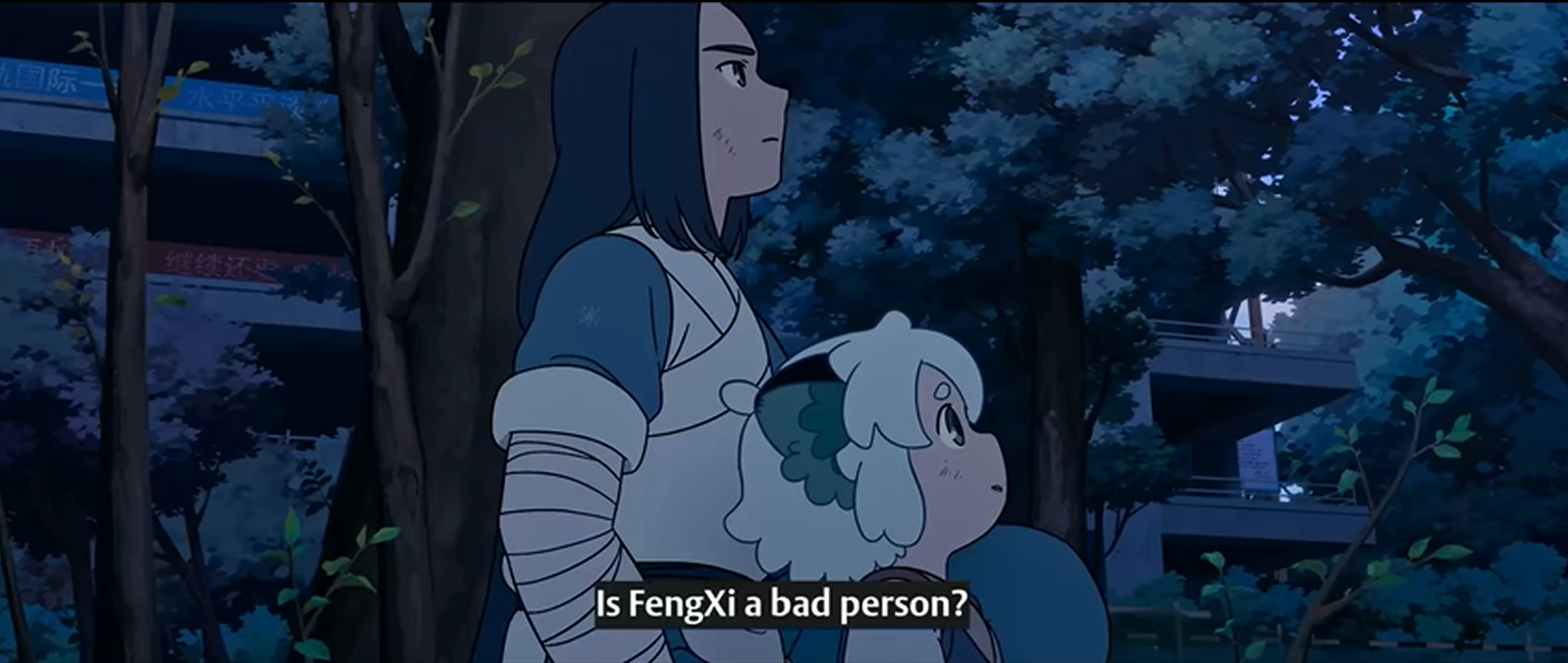
Figure 1. Hei asks whether Fengxi is “a bad person” in The Legend of Hei (2019), crystallising the animation’s refusal of fixed moral categorisation. Copyright Beijing HMCH Anime Co., Ltd.
Conclusion
In light of this change from the surface level of style to the structures of organising conflict, judgment, and relation, The Legend of Hei (2019) is neither a continuation of the older Shanghai model of e.g. ink-painting aesthetics nor simply a Ghibli-adjacent feature reframed through Chinese material. Its surface belongs to a more globally familiar visual language, but its distinctiveness lies in the way it organises meaning through its deeper structures. The animation’s value lies not in displaying elements of Chinese culture more insistently, but in how it structures conflict, judgment, and relation by showing how cultural specificity can remain active even when it is no longer carried primarily by its aesthetic form.
Rather than resolving the broader question about the stylistic, which is facing contemporary Chinese animation, the animation makes that question about style more visible. Contemporary Chinese animation is not created from nowhere, but negotiates inherited traditions, global influences, and new industrial conditions. Within this process of negotiation, aesthetic styles may travel, but meaning does not disappear. The Legend of Hei (2019) suggests an area of animation still in transition, yet still capable of thinking through its own forms.
References
Big Fish & Begonia (大鱼海棠) (2016) Directed by Liang Xuan and Zhang Chun. China: B&T Studio.
Du, D.Y. (2019) ‘Inter/National Style and National Identity: Ink-Painting Animation in the Early 1960s’, in Animated Encounters: Transnational Movements of Chinese Animation, 1940s–1970s. Honolulu: University of Hawaii Press, pp. 114–151.
Green Snake (白蛇2:青蛇劫起) (2021) Directed by Amp Wong. China: Light Chaser Animation.
Mok, B.K.M. (2020) ‘Reconsidering Ecological Civilization from a Chinese Christian Perspective’, Religions, 11(5), 261. Available at: https://www.mdpi.com/2077-1444/11/5/261 (Accessed: 1 April 2026).
The Legend of Hei (罗小黑战记) (2019) Directed by Ping Zhang [MTJJ]. China: Beijing HMCH Anime Co., Ltd.
The Legend of Luo Xiaohei (罗小黑战记) (2011– ) Created by MTJJ. China: HMCH Anime.
Wang, C. (2022) Highlighting the Role of Traditional Spirituality in Independent Chinese Animation: Big Fish and Begonia. MA thesis. University of Victoria. Available at: https://dspace.library.uvic.ca/server/api/core/bitstreams/80f8a38d-3bd7-4481-8a0b-21433396431e/content (Accessed: 1 April 2026).
Wang, Z.D., Yang, Z., Wei, X., Hu, H. and Li, Y. (2022) ‘Unity of heaven and humanity: Mediating role of the relational-interdependent self in the relationship between belief in a zero-sum game and happiness’, Frontiers in Psychology, 13, 958088. Available at: https://www.frontiersin.org/journals/psychology/articles/10.3389/fpsyg.2022.958088/full (Accessed: 1 April 2026).
White Snake (白蛇:缘起) (2019) Directed by Amp Wong and Zhao Ji. China: Light Chaser Animation Studios and Warner Bros. Far East.
Zhou, W. (2021) Chinese Independent Animation: Renegotiating Identity in Modern China. Singapore: Palgrave Macmillan.
Dr Myria Christophini is a Cypriot and Scottish artist and animation scholar. She has held academic posts, among others, at Xi’an Jiaotong–Liverpool University and Edinburgh College of Art, teaching animation, visual arts, visual communication, film, and creative technologies. Her creative work spans animation, drawing, painting, and moving image, with research interests in visual storytelling, socially engaged practice, national animation traditions and animation and social change. Her work has been presented internationally through publications, screenings, and exhibitions, including a solo exhibition at H+ Contemporary Art Museum in Suzhou in 2025. Her film Love Letter to Glasgow (2022) received first-prize awards at festivals, such as at the Scottish Short Film Festival, Seoul International Short Film Festival, and Madrid International Short Film Festival.