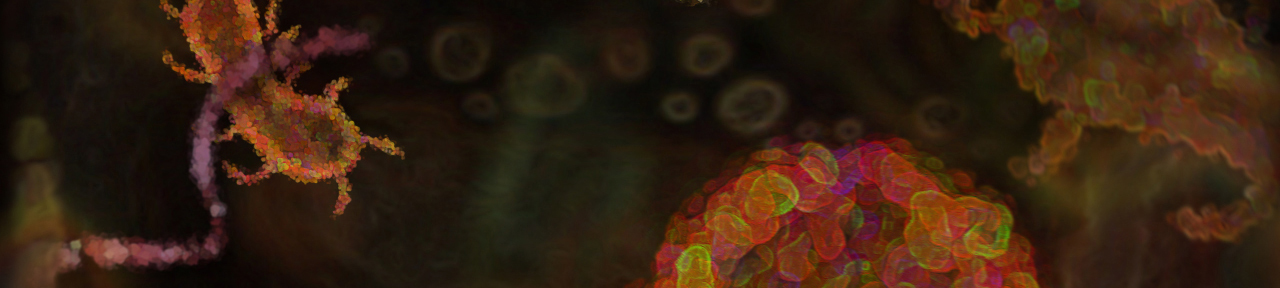
The abundance of fantastical plant life is one of the defining characteristics of the visual identity and world-building in the Hong Kong animated feature Another World 世外(Ng, 2025), which is richly rendered through hand-drawn 2D animation. This text explores how Another World reconfigures the conventional boundary between background and foreground by centring plant life as a narrative and aesthetic force, and through the interplay of monstrous and sublime vegetal imagery portrays the porous boundary between life and death.
Plant life is central to the plot of the animation, as the fate of the characters is determined by whether a “seed of evil,” as the visual metaphor for the culmination of a lifetime’s pain and anger, will flower within a human’s soul. These seeds can be understood as an instance of “vegetal horror” theorised by Dawn Keetley (2016: 12), particularly in her argument that “the human harbours an uncanny constitutive vegetal.” (Keetley 2016: 16).
Plant life is thus integral to both the visual and narrative identity of Another World (2025), especially in its juxtaposition of the monstrous and the sublime. Furthermore, the prominence of vegetation, typically confined to animated backdrops, subverts the conventional relationship between foreground and background elements, highlighting a broader shift in contemporary animation towards destabilising this hierarchy.
The Insubordination of Animated Backgrounds
Often relegated to the background of animation as nature or scenery, plant life in Another World (2025) resists this passivity to contend with the foreground characters, human or otherwise. While this prominence is particularly striking in Another World, it also reflects a broader shift in contemporary 2D animation. Advances in digital tools and hybrid 2D/3D workflows have enabled the creation of more dynamic and complex environments, moving away from the static backgrounds of classic cel animation.
This shift has implications beyond the technical. As the distinction between animated backgrounds and characters becomes less clear, so too does the boundary between subject and object, or human and nature. In this context, Another World foregrounds plant life not merely as environment but as an active narrative and aesthetic force, contributing to a wider reconsideration of the role of the animation background.
Seeds of Evil and the Monstrous Vegetal
Plant life in Another World (2025) does not remain static in the background; the agency of plants is key to the plot progression and central conflict. The animation follows the journey of a soul, initially that of a girl named Yuri, who, after crossing into the liminal space of another world, also called shiwai 世外, for reincarnation, experiences a traumatic revelation about her past life. By bringing human suffering into this space between lives, Yuri disrupts the cosmic order. Her spirit guide, Gudo, offers to accompany her through multiple reincarnations in order to atone for this disturbance. Humans’ unresolved grief and anger are represented by a spiky fractal seed of evil, which, when triggered by extreme distress, blooms and transforms humans into wraths, overtaken by violent impulses. Gudo’s task is to prevent this transformation across Yuri’s successive lives.
Although these seeds lead to monstrous transformations, they also possess an unsettling beauty, glowing and blooming into intricate patterns before consuming their hosts. This grotesque plant imagery recalls one of Dawn Keetley’s theses on plant horror, namely that plants recall “an uncanny constitutive vegetal” within the human (2016: 16), foregrounding the disavowed kinship between humans and plants. As Keetley argues, “Plant horror narratives…derive much of their dread, then, from… the ‘plant will’… utterly beyond the realm (and reign) of the rational, volitional self.” (Keetley 2016: 19). The tension between this force and the attempts of Gudo and Yuri’s various incarnations to resist it forms a central dynamic in Another World (2025).
Otherworldly Plant Life
Plant life in Another World (2025) is not, however, limited to the horrific or grotesque forms. From its initial development as a short film, detailed and vibrant landscapes have been central to its visual identity. As director Tommy Ng (Galwey, 2026) notes, plant life plays a key role in establishing a world that is “both dazzling and serene, giving you a deep sense of peace.” The unusual red colour of the vegetation also serves as a valuable shorthand for “a world that would clearly stand apart from reality.”
The sense of peace and sublimity described by Ng is reinforced by the minimal presence of humanity. Within this other world, humans relinquish their identity, memories, and regrets before moving from one life to the next and the ethereal design of this space de-centres human experience and de-familiarises the landscape (figure 1). Plant life thus functions as a means of conveying the serenity and liminality of the afterlife. In contrast to the monstrous vegetal, this can be understood as a form of the sublime vegetal, in which plant life evokes both fear and delight.
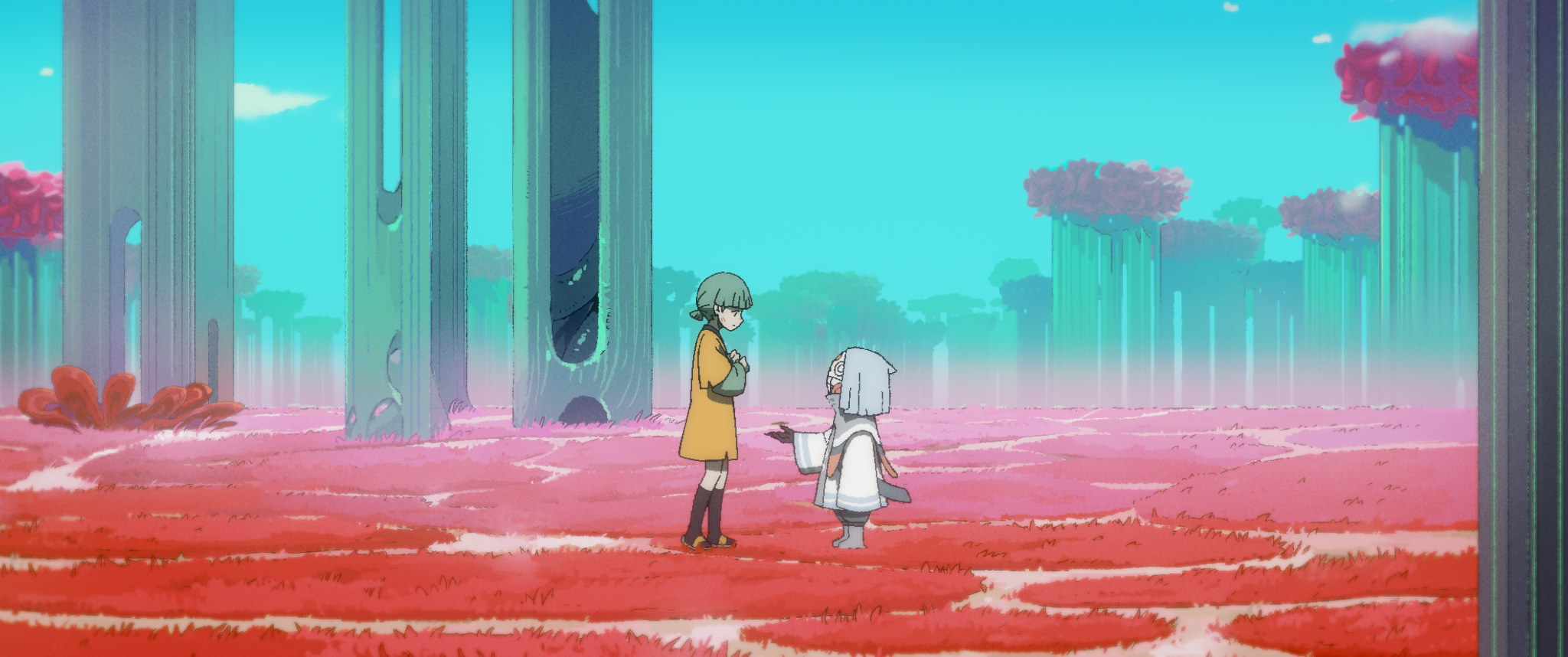
Figure 1. A still from Another World (2025) featuring the red grass and other unusual plant forms that make the landscape visually distinctive as it becomes de-familiarised. Point Five Creations, all rights reserved.
The conclusion of Another World (2025) brings together the violent potential of the seeds of evil and the serenity of its otherworldly landscapes, suggesting a mode of existence that both acknowledges and exceeds the human. As Keetley (2016: 1) observes, “plants also embody… the mortality intrinsic to all natural beings.” In this sense, Another World (2025) presents plant imagery as a source of both horror and the sublime, integral to its aesthetic and narrative development.
References
Another World. Directed by Tommy Ng Kai-chung. Point Five Creations, 2025.
Keetley, Dawn, and Angela Tenga. Plant Horror: Approaches to the Monstrous Vegetal in Fiction and Film. Palgrave Macmillan, 2016.
Galwey, Isabel. “Bringing ‘Another World’ to Life: Polly Yeung & Tommy Ng Interview”[Online]. Skwigly Animation Magazine, January 30, 2026. https://www.skwigly.co.uk/another-world-polly-yeung-tommy-ng-interview/.
Isabel Galwey completed her BA in Chinese Studies at University of Oxford and holds a MPhil in Animation Studies from Hong Kong University of Science and Technology. She is now a first year PhD student in Chinese Studies at Oxford focusing on disrupted boundaries of humanity and animacy in Chinese speculative fiction, and on the increasing ubiquity of speculative fiction’s aesthetics and tropes in everyday life. Her recent publications include the chapter “The Digital Turn in Hong Kong Independent Animation” in Chinese Animation: Multiplicities in Motion (2025) and a section on Hong Kong animation for the forthcoming Encyclopaedia of Animation Studies, Vol 1 by Bloomsbury. She is also a filmmaker, and her debut feature as writer and animator on Washed Up (2026) premiered at the British Film Institute in March.