
The animation film Lesbian Space Princess (2025, Hobbs & Varghese) is a radical counter-utopian experiment in animated worldbuilding. It utilizes animation’s capacity to re:imagine and re:configure without an indexical link[1] to construct a homonormative society while avoiding the trap of creating an inaccessible queer utopia.
On Clitopolis, only lesbians reside, and our protagonist, Princess Saira, is not framed by homophobic or racist oppression[2], but by the quiet, internal struggle of self-doubt. Lesbian Space Princess’s (LSP) homonormative worldbuilding allows Saira’s struggles to emerge detached from the assumption of a homophobic cause. This repositions her subjectivity in its autonomous emotional and psychological complexity. Saira thus gains agency not by being freed from her queerness, but by being relieved from the burden of queerness as a problem (Gowlett, 2014, 416)[3]. In this way, agency extends beyond a character to animation’s ability to construct its own alternative realities in a form of performative agency and meaning-making. Animation’s anarchic freedoms – a term I use to describe animation’s capacity to create beyond physical, social, and epistemic constraints – enable this re:imagination[4] (cf. Wells, 1998, 25), rendering it a unique tool for queer “epistemic labor”, knowing and creating worlds beyond dominant frameworks.
When queer lesbian struggle is usually about safety or visibility, this film’s setting allows Saira’s to be about belonging, self-worth, and the quiet pain of feeling ‘too quiet’ in a world that celebrates loudness. This is not a rejection of queer loudness as survival strategy in the face of erasure. Instead, LSP creates a site of valid critique of queer individuals and relationships without invoking heteronormative frameworks, which is made possible precisely by animation’s representational freedom: Saira’s lesbian mothers, queens of Clitopolis can then, without inviting ctitique of their existence as queer parents, be still criticised for being inattentive and self-absorbed parents to their daughter, who does not fit into their loud and public world. Thus, LSP imagines a world where queerness can also be soft, private, and still valid.
This is complicated through Saira’s (ex-)girlfriend Kiki, a butch lesbian who embodiesa performative masculinity. She is not villainized for being butch, but for enforcing a narrow, exclusionary standard of lesbian identity that equates visibility with legitimacy. Kiki’s failure is not her queerness, but her inability to see Saira’s quietness as valid. Kiki stands representative of the support Saira has lacked to reclaim her agency. This crucially reframes Saira’s journey from ‘becoming strong’ to learning the tools to face her anxious inner world.
Rather than simply creating a queer utopia (although god:dess:es know:s we deserve it) LSP refuses this form of totalization. Instead, it introduces the ‘Problematic Ship,’ which spews misogynistic, homophobic nonsense. When Saira and Willow ironically degrade the ship’s rhetoric to the 21st century, it responds with a comic, yet chilling ‘yes’. The moment is more than satire, it’s a rupture in LSP’s world and a sudden return to the audience’s own reality, echoing the uncomfortable truth that the default in our current world is hate speech penetrating queer existences and bigotry weaponized through irony.
LSP’s visual logic is central to this disruptive scene. When the viewers are introduced to a potential villain’s square shadow, a queer audience might instinctively assume something ‘straight’. And indeed, the ‘straight white Malians’, simple paper strip caricatures, are introduced as initially flat, cartoonish villains, who later demonstrate much more depth than their simple design wants to make us believe (fig.1). Unlike other narratively restricted, more one-dimensional ‘evil’ characters, such as the drag queen Blade or Saira’s mothers, the Malians offer actual critique of masculinity in crisis and confess to feeling alienated, emasculated, and trapped by rigid gender roles. LSP thus humanizes them by granting them a voice, emotional depth, and Saira’s compassion. The film refuses to mirror the historical patterns of dehumanization to the Malians. Clitopolis’ queer normativity becomes patriarchy’s worst nightmare, where straight-white-men are dethroned, re:imagined as marginalized, no longer heroes, and forced to reconsider their masculinity and fragility, navigating a world where they are no longer the oppressor. But LSP goes on to invite the Malians into the narrative as more than just a punchline, as it mocks all characters alike, it invites them as subjects of reflection.

Figure 1: the ‘Straight White Malians’. Still from Lesbian Space Princess (2025). Courtesy of Salzgeber.
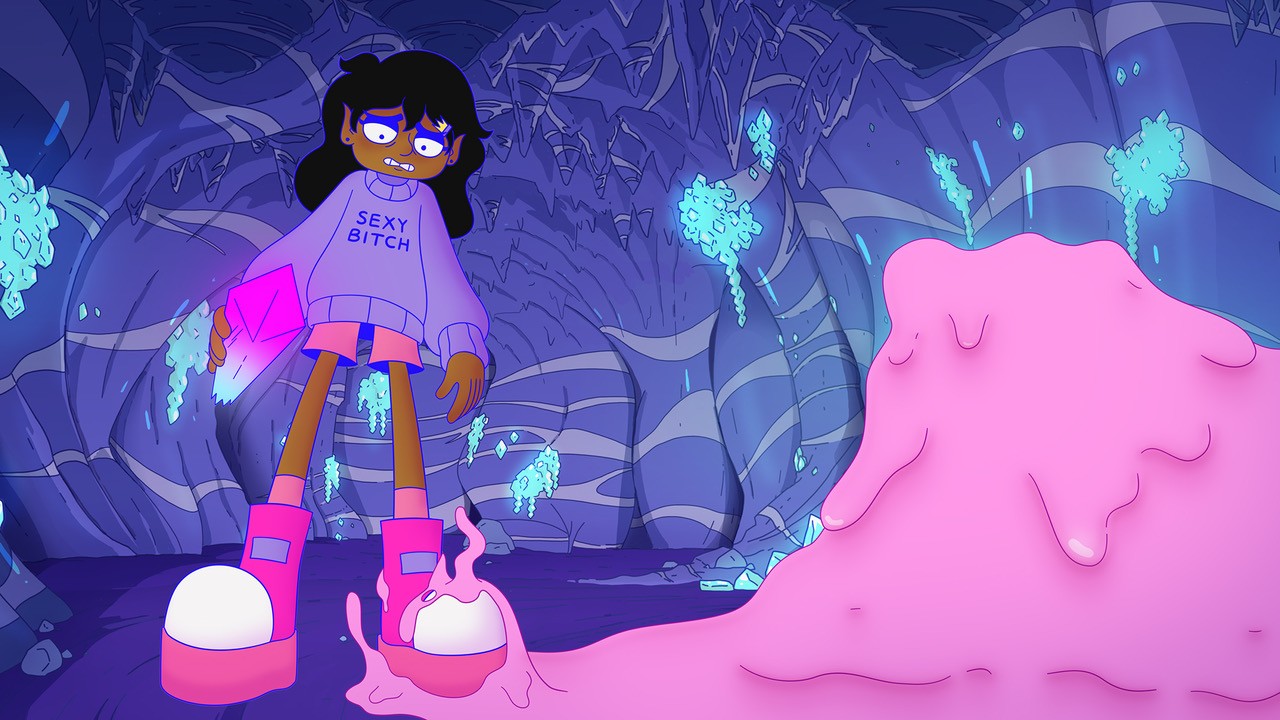
Figure 2: Princess Saira. Still from Lesbian Space Princess (2025). Courtesy of Salzgeber.
The film’s campy-colored palette and blue line art create queer optics (fig.2), a visual epistemology that resists normative realism (cf. Wells, 1998, p. 27). Through camp, described by Sontag as a “spirit of extravagance” (1999, 25) and Babuscio’s four pillars (irony, aestheticism, theatricality, and humor; 1999, 119), LSP’s animation turns exaggeration, parody, and meta-gags into epistemic tools, showcasing that queerness can be playful and the norm, and that color is not decoration but a subversive refusal of realism to offer new ways of seeing, feeling, and knowing.
This rare homonormative worldbuilding – before reintroducing heteronormativity through absurdist and satirical disruptions (i.e. the Problematic Ship, the Malians) – utilizes animation’s unique abstraction capabilities to re:imagine realities. Animation’s representational freedom enables the construction of realities largely freed from stereotypes tied to photoindexical realism (cf. Buchan, 2014, 122ff.). In that sense, animation is epistemic to itself by creating a world that comes from queer knowledge. LSP enables queer and non-white characters to access agency not through survival or problematizing their identities, but through their mere existence, granting them complexity. This agency emerges both narratively and through the film’s animated form: LSP’s campy style itself is resistance: “One is drawn to Camp when one realizes that ‘sincerity’ is not enough” (Sontag, N42) or as ‘black, lesbian, mother, warrior, poet’ Audre Lorde phrased it with the title of one of her texts: “The Master’s Tools Will Never Dismantle the Master’s House” (2018). Lord’s insistence that transformation cannot happen through the oppressor’s tools makes visible how LSP, in crafting its own visual logic, performs its own form of knowing and resistance.
Shaped by (internet) culture, community jokes, and meta-winks at the audience, LSP emerges from an extensive queer history that created coded subcultures. Animation functions both as a medium and a method of resistance. Its representational freedom allows LSP to create this extension of queer people’s historical labor, who, through decades of erasure, developed shared codes to survive, recognize each other, and create knowledge of and for themselves. In that sense, LSP can be understood as a shared epistemic labor as a form of sustained, transgenerational, transnational practice of meaning-making through which marginalized identities create new worlds of meaning and understanding. Expressed through animation, LSP enables both the creators as well as the audience, who are, in a sense, co-creators in this process, to render this collective knowing visible and imaginable.
Endnotes
[1] This understanding of animation’s representation mode follows Peirce’s semiotic framework to distinguish between index (causally connected to its object), icon (resembling the object), and symbol (conventionally associated). Maureen Furniss (1998, 5) describing animation’s representational mode “between mimesis and abstraction” and Nea Ehrlich (2011) as “physically un-indexical” highlights how animation can operate in a space beyond indexicality.
[2] While LSP’s visual counter-hegemony in creating homonormativity and queer agency is primarily focused, this essay is aware of the entanglement of race and queerness. LSP’s worldbuilding similarly destabilizes whiteness, another aspect that animation uniquely enables through its abstraction. The film adequately situates queerness and race as entangled struggles along the spectrum of the human and less-than-human. I explore this in greater depth in my dissertation.
[3] Christina Gowlett (2014) frames agency in a Butlerian sense as performative. It is not Saira’s queerness that gives her character agency, but the removal of oppressive constraints to her queerness. Saira’s agency, then, is not about liberating the lesbian subject but about disrupting, reworking, negotiating, or unsettling norms and constraints that limit her, showing that “social norms are porous and can be reworked” (ibid., p. 416).
[4] I use the colon in words such as re:imagination to visually emphasize the prefix. This form is additionally chosen as many screen readers (depending on the software) read the colon as a brief glottal pause making the text more accessible.
References
Babuscio, Jack. 1999. “The Cinema of Camp (aka Camp and the Gay Sensibility).” In Camp. Queer Aesthetics and the Performing Subject: A Reader, edited by Fabio Cleto, 117–135. Ann Arbor: University of Michigan Press.
Buchan, Suzanne. 2014. “Animation, in Theory.” In Animating Film Theory, edited by Karen Beckman, 111–27. Duke University Press. https://doi.org/10.1215/9780822376811-008.
Peirce, C. S. 1932. Collected Papers of Charles Sanders Peirce, Vol. 2: Elements of Logic, edited by Charles Hartsthorne and Paul Weiss. Cambridge, MA: Harvard University Press. §§ 2.247-2.249
Ehrlich, Nea. 2011. “Animated Documentaries as Masking.” Animation Studies 6.
Furniss, Maureen. 1998. Art in Motion: Animation Aesthetics. London: John Libbey.
Gowlett, Christina. 2014. “Queer(y)ing and Recrafting Agency: Moving Away from a Model of Coercion versus Escape.” Discourse: Studies in the Cultural Politics of Education 35 (3): 405–418.
Lorde, Audre. 2018. The Master’s Tools Will Never Dismantle the Master’s House. London: Penguin Classics.
Sontag, Susan. 1999. “Notes on ‘Camp.’” In Camp. Queer Aesthetics and the Performing Subject: A Reader, edited by Fabio Cleto, 53–65. Ann Arbor: University of Michigan Press.
Wells, Paul. 1998. Understanding Animation. London New York: Routledge.
Sanny Schulte is a film studies researcher and PhD-candidate at the University of Tübingen. Their dissertation project, Animated Configurations of Otherness, explores animation’s potential to re:imagine and re:configure at the intersection of animation aesthetics and sociocultural transformation with a particular focus on FLINTA*-queer, disability, and ecological otherness. They received the State-Postgraduate-Fellowship for their dissertation, work at the open-access journal Colour Turn and the Media Studies Institute. Sanny has worked in numerous film productions and is part of the production and directing team for the University of Tübingen anniversary film.