One of the characteristics of animation is that it offers the illusion of life, in which passive materials are transformed into living entities with agency of their own. A range of animated films from Bambi (Hand, 1942) to The Jungle Book (Reitherman, 1967) and The Wild Robot (Sanders, 2023) features talking animals with varying degrees of anthropomorphisation, as a means to explore the relationship between human and non-human nature. The presence of animals endowed with (anthropomorphic) agency, however, did not in itself ensure ecologically progressive messages. To the contrary, it often reinforced the binary opposition between human and non-human nature. As Ursula Heise aptly puts it : “By questioning how and why we discover agency in nonhumans, how organisms become objects and objects organisms, animated film persistently draws attention to the reification of nature in modern societies and its opposite, the encounter with nature as a realm populated by a variety of nonhuman agents.” (Heise, 2014, p. 304). In what follows, I will use the example of Chicken Run (Lord & Park, 2000), to explore how the animation is interrogating the question of agency by focusing on material connections, instead of the abstract and often magical metaphorical approaches frequently used in animations featuring animals.
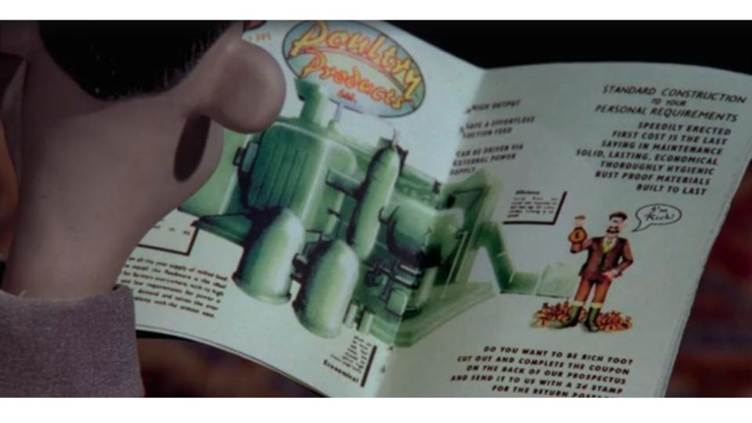
Fig. 1: Mrs. Tweedy and the pie machine. Screenshot from Chicken Run (Lord & Park, 2000).
Chicken Run examines the relationship between the living and non-living, between the animate and the inanimate, in light of the machine-human and machine-animal relationship; and at the same time, it interrogates the relationship between humans and non-humans through the animal-human relationship. The fourth wave of ecocriticism, shaped by post-human and new materialist theories, focuses on similar boundaries between human, animal, and the machine (Marland, 2013). Transcending humanism also means questioning the concept of humans being the only ones bearing agency (Feder, 2014, p. 235). In rethinking agency, identity, and materiality, posthumanism posits an interaction in which humans cannot claim ontological detachment from non-human nature. Material interaction transcends the boundaries between species, humans and non-humans, and technology, which implies that humans are not at one end of the nature-culture binary, but appear as hybrids on this continuum. Stacy Alaimo describes this with the term “transcorporeality”, which essentially refers to a fluid, membrane-like permeability between the biological, social, and political spheres, meaning that humans are always in a material relationship with non-human entities (Alaimo, 2010, p. 2). In line with this, exploring the narratives ‘told’ by the storied matter[1] (Oppermann, 2016, p. 274) can help reveal these connections. In Chicken Run, the storied matter is meat and its biological origin, the chicken. The two contrasting symbols of the intertwining of the biosphere and technosphere are the pie-making machine of Mrs. Tweedy (see Fig. 1) and the flying machine (see Fig. 2), which the chickens create to escape. Mrs. Tweedy welcomes the pie-making machine as something that “will take Tweedy’s farm out of the dark ages, and into a full-scale automated production” (34:06).
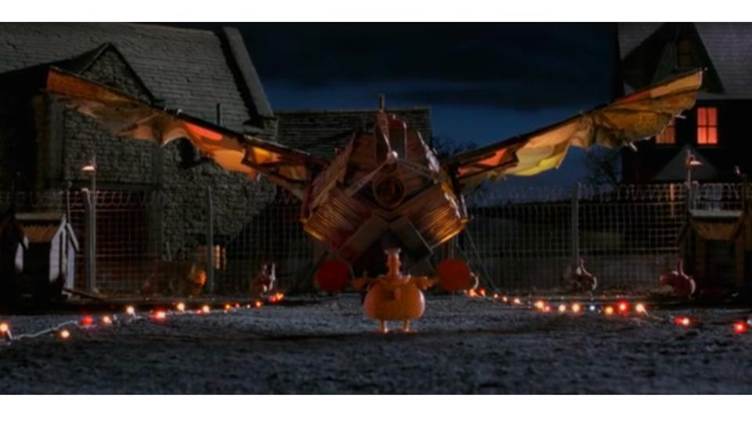
Fig. 2: The flying machine. Screenshot from Chicken Run (Lord & Park, 2000).
The machine thus embodies the idea of progress that is so often condemned in ecocriticism (Huggan & Tiffin, 2015, p. 29). Progress, a euphemism that legitimizes more efficient exploitation, is of course not important to Mrs. Tweedy as an abstract concept, but represents a hope of greater financial gain. The chickens, as living beings, do not appear in this vision apart from being a raw biological material to be fed into the machine, which can be considered as a forerunner of capitalist mass production. At first glance, it may seem as if Chicken Run confirms the idea that chickens are simple-minded animals, and that this is precisely what makes them so controllable. Since most chickens do not understand what it means for them that Mrs. Tweedy is switching from egg production to meat production, they might not have any concept of captivity and freedom. In other words, the silly hen as a cultural construct provides the basis for these creatures to be moulded into docile bodies (Foucault, 1975/1995, p. 136) that can be easily disciplined en masse. Yet the film challenges the credibility of social constructs based on species, primarily through the intelligent and proactive characters of Ginger and her friend Mac, an engineer and inventor, who constantly devises new plans to escape from the Tweedy farm. Their determination inspires the other chickens, who are capable of collective cooperation but appear as independent personalities in the film. Chicken Run individualizes the chickens, thus refuting cultural stereotypes about them and the views represented by Mrs. Tweedy, who feeds chickens to food-producing machines, thus degrading them to material entities. A witty symbolic rejection of the idea which equates animals with machines is that the gallus domesticus (chicken), which as a species has been deprived of its ability to fly by human intervention over centuries, eventually builds itself an airplane to escape.
The ability to build and control machines is a distinguishing feature between animals and humans, one that only the latter possess. In the animation, however, animals also become capable of expanding their agency in this way. In doing so, the film rejects the notion that the greatest difference between humans and animals is that animals lack certain skills or abilities that humans possess (Calarco, 2020). Not only does it refuse the deficit based distinction, but also the very comparison of humans and animals as a central issue. Humans, whose bodies consist in part of animal-derived meat, and chickens, whose bodies have been modified on an evolutionary scale by human intervention, are materially connected and inseparably intertwined, thus rendering the dualistic approach obsolete. Chickens want to literally break free from this web, but it is telling that in order to do so, they must resort to a tool such as the airplane, which is a uniquely human one. Thus, the use of anthropomorphism in Chicken Run serves both as a means to endow chickens with agency, and draw attention to the material intertwining of human and non-human nature, while at the same time proposing that only by becoming more human-like can non-human nature act on its own. The latter however is a case in point for Claire Parkinson’s (2020) argument, who claims that narratives made up by humans are inevitably anthropomorphised to a certain degree, which can serve as a means to enforce empathic identification with non-human nature.
Endnotes:
[1] As Serpil Oppermann (2016, p. 274) explains, the storied matter and narrative agency are key concepts of material ecocriticism, which reveal narratives embedded in material formations and expose the intertwining of matter and agency between human and non-human nature, and in the case of posthumanism, the technosphere.
References:
Alaimo, Stacy (2010). Bodily Natures. Science, Environment and the Material Self. Bloomington: Indiana University Press. https://doi.org/10.2979/6079.0.
Bambi (US 1942, David Hand).
Calarco, Matthew R. (2020). Animal Studies. The Key Concepts. London/New York: Routledge. https://doi.org/10.4324/9780429019326
Chicken Run (UK 2000, Peter Lord, Nick Park).
Feder, Helena (2014). Ecocriticism, Posthumanism, and the Biological Idea of Culture. In: G. Garrard (ed.), The Oxford Handbook of Ecocriticism. Oxford: Oxford University Press, pp. 225‒240. https://doi.org/10.1093/oxfordhb/9780199742929.013.006
Foucault, Michel (1995 [1975]). Discipline and Punish. The Birth of the Prison (transl. by A. Sheridan). New York: Random House.
Heise, Ursula K. (2014). Plasmatic Nature: Environmentalism and Animated Film. Public Culture, 26, pp. 301‒318. https://doi.org/10.1215/08992363-2392075.
Huggan, Graham; Tiffin, Helen (2015). Postcolonial Ecocriticism. Literature, Animals, Environment (2nd ed.). London/New York: Routledge. https://doi.org/10.4324/9781315768342-9.
Marland, Pippa (2013). Ecocriticism. Literature Compass, 10(11), pp. 846–868. https://doi.org/10.1111/lic3.12105.
Oppermann, Serpil (2016). From Material to Posthuman Ecocriticism: Hybridity, Stories, Natures. In Hubert Zapf (ed.), Handbook of ecocriticism and cultural ecology. Berlin: De Gruyter, pp. 273–295. https://doi.org/10.1515/9783110314595-016.
Parkinson, Claire (2020). Animals, Anthropomorphism and Mediated Encounters. London/New York: Routledge. https://doi.org/10.4324/9780429203244.
The Jungle Book (US 1967, Wolfgang Reitherman).
The Wild Robot (US 2024, Chris Sanders).
Virág Vécsey is assistant professor at the Faculty of Humanities at the Eötvös Lóránd University (ELTE), Budapest. Her fields of research are animation studies, environmental communication and CEE cultural studies. Her doctoral research explores how European animation represents human-nature relationships since the fall of the Iron Curtain in context of the changing social, political and industrial landscape. She is the founder and head of the Media design specialisation at the Department of Media and Communication at ELTE.