
Destructive yet corrective, social yet subjective, the contradictory nature of humour makes it difficult to define. This is perhaps never more apparent than when humour relies upon the seriousness of its given topic. Over and above philosopher Arthur Schopenhauer’s claim that behind all humour ‘the deepest seriousness is concealed and shines through’ (2012: loc. 4355), humour that foregrounds its own inappropriateness can perform important cultural work. This text posits the animated tv series BoJack Horseman, created by R. Bob-Waksberg for Netflix between 2014 and 2020, as an ideal site to interrogate this process of cultural work by using the show’s opening scenes to unpack how its style of animation is juxtaposed against its ostensibly un-funny subject matters to initiate timely and necessary conversations.
BoJack Horseman is set in a surreal version of contemporary Hollywood, named ‘Hollywoo’ in the sixth episode, where humans and anthropomorphised animals work alongside one another in an absurd, hyper-commercial entertainment industry. The show’s protagonist – the eponymous horseman, BoJack – is an aging actor trying to escape the shadow of the hit sitcom Horsin’ Around that originally brought him stardom. Referred to as a ‘sadcom’ by Sawallisch (2021: n.pag.) due to its overlap between tragic and comic modes, I argue that BoJack Horseman uses animation to create humour by reaching for emotional responses with negative hedonic valence that then appear incongruous, simultaneously appropriate and inappropriate, when set against its particular aesthetic. BoJack Horseman establishes this sense of incongruity from the outset when it opens with a clip from Horsin’ Around:
[Interior: Kitchen decorated in the style of America in the 1980s. BoJack washes up at the sink. Sarah sits down at the table.]
Sarah: [sighs] Mondays.
Audience: [laughs]
BoJack: [laughs] Well, good morning to you too.
Sarah: Oh, hey.
BoJack: [drops a plate and looks around, visibly excited] Where? I’d love hay.
Audience: [laughs]
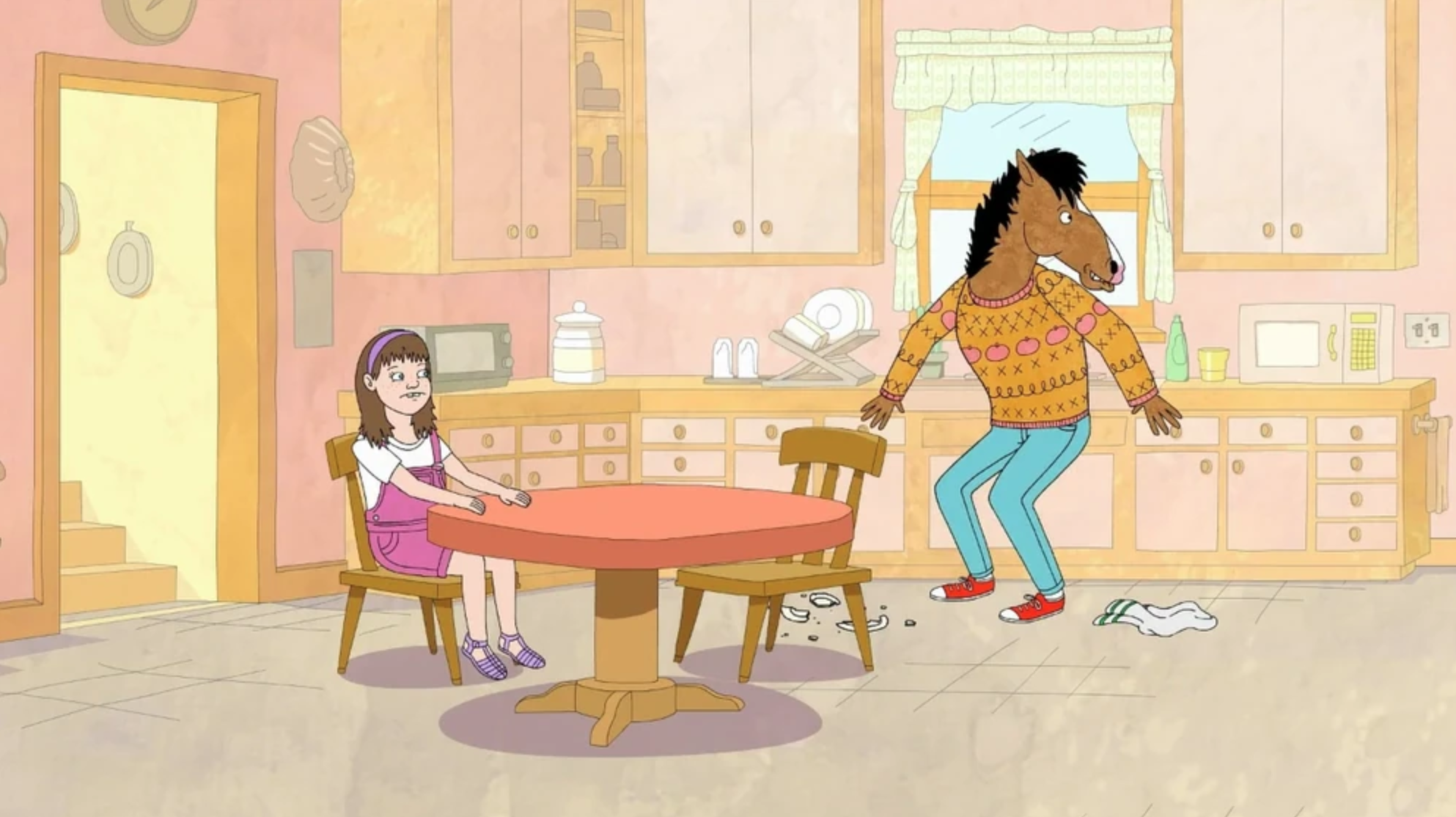
This scene is then interrupted by an interview with present-day BoJack, who reveals that he parked in a spot for disabled badge holders and that he is too drunk to move his car, before using crass language to defend his old show. The former section uses a cliché joke and the obvious pun hey/hay alongside 2D animated design, bold lines, pastel colours and ‘zany anthropomorphism’ (Varela 2024: 13) (see Figure 1) to create a sense of visual and moral simplicity. The live interview subverts this visually through a darker palate, dialogically through BoJack’s ethically questionable attitudes and audibly through the awkward pauses that replace Horsin’ Around’s studio laughter (see Figure 2). The animation style itself provides enough of a through-line to signal that this is the same whimsical character we saw in the sitcom, yet the incongruous appearance of drunk driving, crude language and aggression shatters the illusion that said whimsy could ever be divorced from a problematic reality.
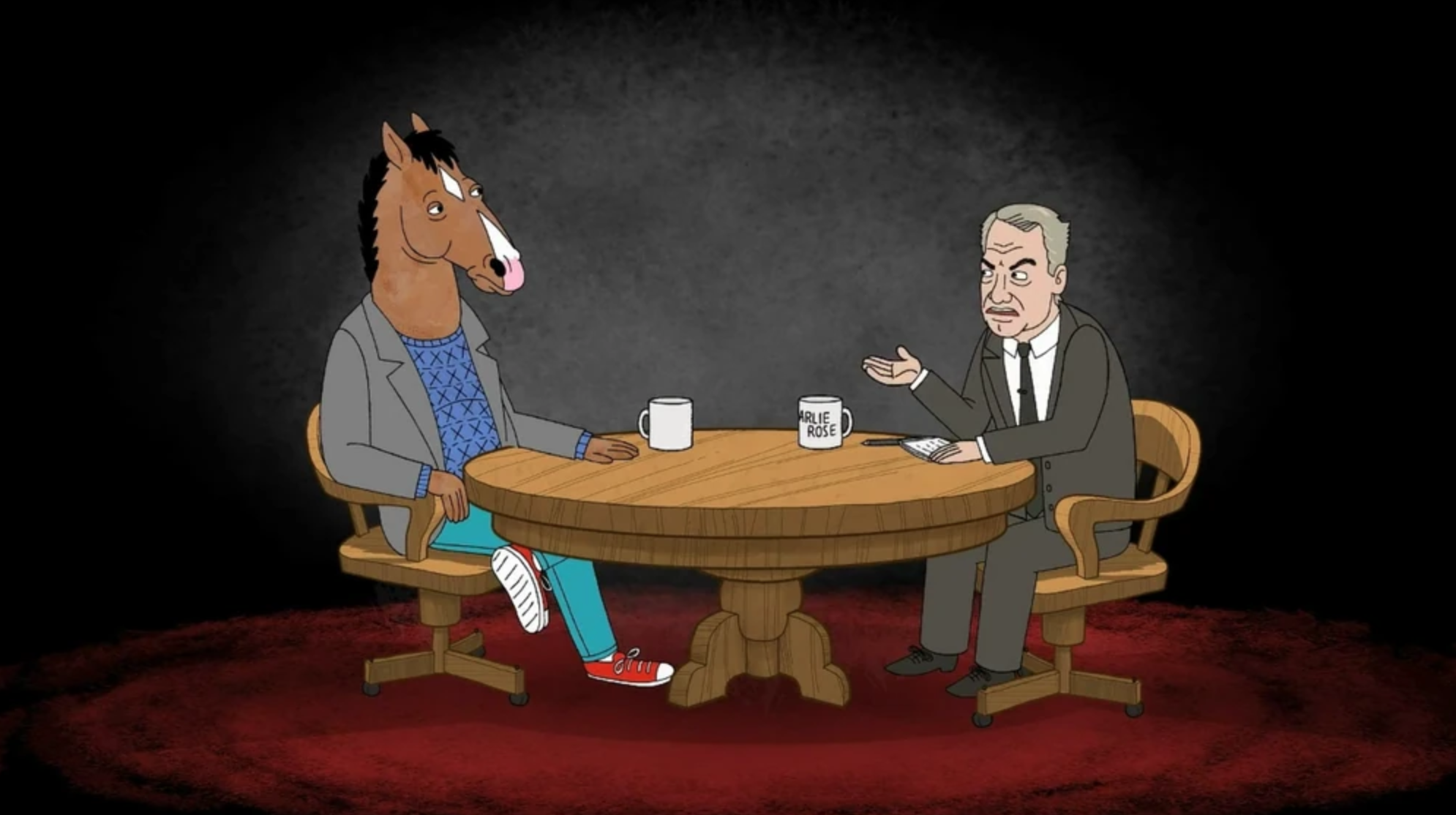
Humorous potential is created through the incongruous collocation of the prior sense of wholesomeness alongside BoJack’s inappropriate comments and the resultant sense of tension and unease. On one level this establishes a sense of existential pessimism that, in many respects, becomes the primary antagonist in the series. Said pessimism is made explicit when BoJack calls life ‘one long, hard kick in the urethra’, but the conspicuous lack of laughter or any other response from the audience, alongside the interviewer’s minimal objections, further underscores this by emphasising that nobody is holding BoJack to account. The resultant ‘comic nihilism’ is an increasingly popular form of humour that Holm and Donian characterise (2024) as both an expression of life’s fundamental meaninglessness and a defence against it. Even as BoJack decries the world as fundamentally cruel, humorous depictions of this sad state of affairs ameliorate the psychological pressure it exerts and encourage the repudiation of (self)destructive values and assumptions.
On another more expedient level, however, this opening draws a stark contrast between the softened, simple, easy world created by light entertainment – caricatured here by Horsin’ Around – and the complicated social reality that BoJack wishes to escape. Between his defence of escapism and performative political correctness when replying ‘I’m sorry, “disabled” spot. Is that the proper nomenclature?’, BoJack reveals a deep-seated dissatisfaction. His consequent subversion of the gestalt created by the Horsin’ Around clip signals that BoJack Horseman will be anything but what BoJack claims he longs for: ‘a show about good, likable people who love each other’. Indeed, BoJack Horseman reaches new levels of emotional poignancy through decidedly non-whimsical and not-zany depictions of addiction, depression, guilt and toxicity, not to mention struggles for identity, integrity and moral justice. But as BoJack himself demonstrates through his anxious interruption of his own diatribe in favour of escapism (‘Did I already say the thing about the urethra?’, he asks) reality has a way of penetrating comforting illusions, undermining the shallow simplicity that the show’s animation style and quirky setting initially offer, and demanding that one confront the emotional and political problems that motivate escapism in the first place.
The absurdity of BoJack Horseman’s setting – both the fictional Hollywoo and the real world it satirises – is foregrounded as much by the aesthetic as its plot, which together bely this world’s unreality and its hyperreality. The friction between these aspects of the show is a continual source of incongruity, and the humour in BoJack Horseman’s is therefore always informed by the (in)appropriate juxtaposition of a bright and bold world against the moral void that underpins it.
References
‘BoJack Horseman: The BoJack Horseman Story, Chapter One’ (2014), R. Bob-Waksberg (dir.), BoJack Horseman, Season 1 Episode 1 (22 August, USA: Tornante Television, Boxer vs. Raptor and ShadowMachine)
Holm, N. and Donian, J. (2024), ‘“I am in great pain, please help me”: Nihilism, humour, and Rick and Morty’, Critical Studies in Television: The International Journal of Television Studies, online first, https://doi.org/10.1177/17496020241301585.
Sawallisch, N. (2021), ‘“Horsin’ around”? #MeToo, the sadcom, and BoJack Horseman’, Humanities, 10:4, https://doi.org/10.3390/h10040115.
Schopenhauer, A. ([1818] 2012), The World as Will and Idea (Volume 2 of 3), n.p.: Project Gutenberg.
Varela, J. (2024), ‘More horse than a man, or more man than a horse: Rethinking masculinity through zany anthropomorphism’, in H. E. H. Earle (ed.), Aren’t You BoJack Horseman? Critical Essays on the Netflix Series, pp. 13–29, Jefferson, NC: McFarland & Company.
Oliver Rendle received his Ph.D. from Manchester Metropolitan University in 2022, specialising in humour theory and philosophical pessimism, and is currently a writer and independent researcher based in Bristol (UK). He is the author of Comic Humour: Philosophical Pessimism in Contemporary Culture (Bloomsbury 2026) and his peer-reviewed articles appear in Pulse: The Journal of Science and Culture and Game Studies. His fiction has appeared in Seaborne Magazine, Stories From Home (2020) and State of Matter and he is the winner of Waterstones’ 2025 Sir Terry Pratchett Day short story competition.