Colin Williamson’s Drawn to Nature argues that “science animation” is not a niche offshoot bolted onto cartoon history, but a force that has long shaped mainstream American animation. Williamson’s central wager is persuasive: scientific ideas about nature did not merely supply topics for cartoons, but helped animators test what animation can show, how it can move, and what kinds of phenomena it can convincingly propose.
The study opens with an archival hook. Williamson discusses unused Fantasia development sketches that visualise a tree’s internal processes, as if biology had been translated into cartoon motion. From there, he builds a strong case that animation history is often written as though “nature” sits outside the medium’s concerns, when in fact ideas about nature repeatedly pushed technique, style, and theory forward. He frames the project as a “shadow history,” (pg.2) not because the films are obscure, but because the scientific conversations running through them are easy to miss when we confine “science animation” to overtly educational work.
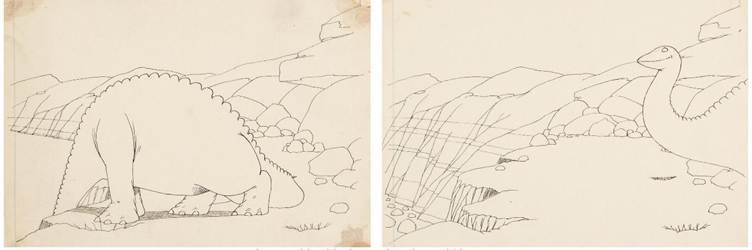
Figure 1- Two hand-drawn animation frames from Winsor McCay’s Gertie the Dinosaur (1914). Public domain. Source: Wikimedia Commons.
The chapters that follow trace this “shadow history” across a series of linked case studies: McCay and early cartoon nature, the Fleischer studio’s popular science, Disney’s craft realism, and UPA’s modernist design culture. The book then moves into postwar scientific visualisation, culminating in Elsa Garmire’s laser imagery as a late-century convergence of animation, instrumentation, and ways of seeing.
A major strength of the book is its transdisciplinary confidence. Rather than adding scientific references onto a familiar canon, Williamson reverses a common direction of travel. Instead of asking only how animation serves science, he asks how scientific discourses shaped animation aesthetics in popular culture. This shift makes familiar stylistic concerns look newly charged beside debates about evolution, realism, and cosmology.
Williamson is at his best when he stays close to style while keeping scientific imaginaries in view. His chapter on McCay is exemplary. Rather than repeating the familiar story of early animation as a theatre of metamorphosis, he situates McCay’s vibrating lines and protean bodies amid ideas of energised matter and evolutionary transformation. Drawing on Eisenstein’s term “plasmaticness,” Williamson links elastic, ever becoming cartoon bodies to broader ways of picturing nature as unstable and in flux. This is an effective move because it resists treating animation’s elasticity as a self-contained formal trick. It becomes, instead, a cultural posture about change, vitality, and the legibility of natural process.
Across subsequent chapters, Williamson continues to treat style as a site where ideas about nature are negotiated. The result is a method: look at how concepts of nature are inscribed on the cartoons themselves and ask what those inscriptions do to our stories about modernity, technique, and visual authority. For readers interested in science communication, the study deepens a point practitioners know. Animation has long been tasked with visualising what cannot be captured directly, whether because it is too small, too slow, too fast, too abstract, or simply unavailable to a camera.
In animation studies, Williamson’s project sits alongside classic accounts of Disney craft and animation aesthetics (Thomas and Johnston; Wells; Furniss) while extending more recent scholarly attention to animation’s modernity and knowledge-making (Gunning; Buchan; Curtis) into the adjacent terrain of science and natural philosophy.
As a scientific animator, I found this recognition genuinely heartening. The book insists that animation is not merely ornament added to science after the fact, but a medium that helps shape how publics imagine nature, and how artists imagine animation’s own powers. In a culture where animation is still too often treated as decoration, Williamson’s project offers a valuable counter history. It places science animation within animation’s core story, not at its margins.
My reservations are, in part, a compliment to the book’s ambition. Drawn to Nature frequently gestures toward a scope larger than its subtitle, then returns to the safety of its stated limits. Williamson is careful to note that his chosen examples do not stand in for all animation, and that ideas of nature are plural and historically variable. That caution is responsible, but it feels self-limiting. The book opens doors onto larger questions about animation’s epistemic role, then steps back just as those questions begin to sharpen.
A related reservation concerns affordance, not as a buzzword, but as a craft problem. Williamson briefly notes why drawn animation has proven so useful in scientific and educational contexts: it can simplify detail, guide attention, show relations, and render change through metamorphosis, including phenomena no camera can verify. Those lines point toward a rich theory of animation as explanation, yet later chapters revisit it only intermittently. This is also where the book’s attention to fantasy and “magic” becomes especially suggestive. For contemporary science animation, the pressing question is not whether animation is magical, but how that magic functions as a social contract. Animated frames can produce wonder, but they also ask for trust. In an era of synthetic images, that trust dimension is central. A fuller account of how animated explanation becomes persuasive, and how persuasion can remain ethically legible, would have extended the book’s strongest impulses.
None of this undercuts the book’s achievement. Drawn to Nature offers a vivid history of how animation has been drawn into scientific ways of imagining, and how science has been drawn into animation’s ways of moving. It supplies case studies that support further scholarship, and it gives practitioners a lineage that legitimates science animation as more than a service role. In the end, Williamson’s book succeeds as a reframing device. It changes what you notice when you watch canonical American cartoons, and it changes what you think science has been doing inside them. I will recommend it widely, both to students learning to read style historically and to animators who want to understand why the animated frame remains such a powerful way to share a vision.
Jack Parry is a scientific animator and academic based at Swinburne University of Technology in Melbourne. Over a 25-year career he has created visualisations that make invisible scientific and biological phenomena perceptible through animation, working across research, education, and communication contexts. His research connects studio practice with post-structuralist approaches to media theory, examining how animation acts as both experiment and explanation, and how moving images externalise models of nature over time. Current work investigates white matter formation as a biological model for learning and memory and explores how animation can render processes that cannot be photographed, directly observed, or easily narrated. Jack teaches animation production and theory and develops workflows that treat making as inquiry. He advocates for animation as not only a unique form of scientific insight and creative practice but a research methodology in its own right.