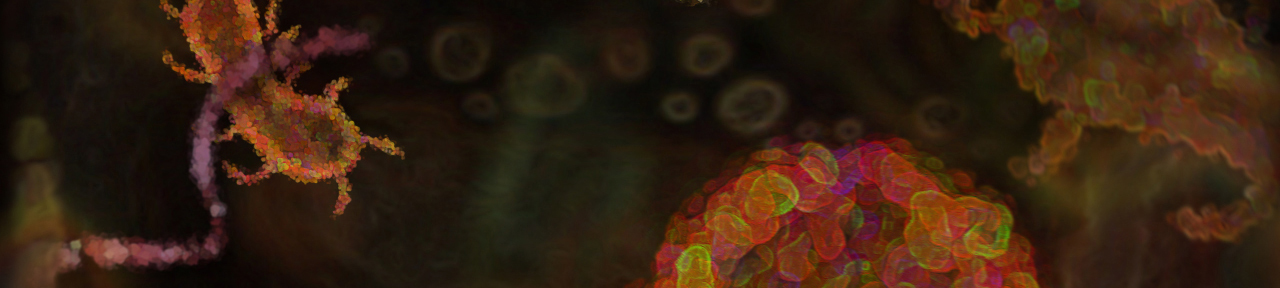
In the opening minutes, Nayola narrates a dream: a man runs naked through tall grass, gunshots crack, he collapses in mud, and a mulemba tree grows from the place where he falls. In the final sequence, a masked figure crosses a terrain scattered with abandoned weapons towards an uncertain horizon, while Bonga’s ‘Mona Ki Ngi Xica’ (1972) plays. These bookends frame war as inheritance.
José Miguel Ribeiro, the film’s director, describes Nayola as focused on the ‘contagious effects’ of war across generations (Animation World Network, 2023). Released in 2022, Nayola is a European transnational animated feature based on A Caixa Preta by Angolan writer José Eduardo Agualusa and Mozambican writer Mia Couto (2019). The film is set against the Angolan civil war (1975–2002) and its aftermath, in the long historical shadow of nearly four centuries of colonial rule. The war is framed not as a finished episode, but as an inheritance carried through land, bodies, and intergenerational memory. Visually, the film combines a drawn 2D aesthetic, painterly digital surfaces, and sharp colour contrasts. It moves between stylised depictions of lived reality and dream imagery. This visual language supports a symbolic system echoing Angolan cultural imaginaries. The mulemba embodies lineage, authority, and shelter, the jackal appears as a boundary-crossing folktale figure. Blood marks violence, sacrifice, and continuity, showing what is transferred, borrowed, or paid for. These metaphors are not decorative. They are central to the film’s way of rendering the war’s afterlife within this women-centred story. At the same time, the film’s transnational co-production context introduces an important tension, as African literary and historical memory is here reimagined through a European production framework.
The narrative follows three women across two temporal zones: wartime scenes in the mid-1990s and a later, post-war moment in 2011. Lelena, the grandmother, lives under the long shadow of violence and loss. Nayola, her daughter and the film’s emotional centre, is driven less by ideology than by survival as she moves through armed spaces and moral ambiguity. Yara, Nayola’s daughter, belongs to the post-war generation but lives inside the conflict’s residues: political anger, danger, distrust, grief, and the sense that history did not end when the guns were supposedly put down. The film’s constant return to the past suggests that the war’s ‘end’ is not the end of its consequences. Yara embodies Hirsch’s ‘postmemory’ (2008: 106–107), and the film’s repeated returns echo Caruth’s account of belated history that disrupts linear narration (1996: 7). Nayola treats inheritance not as an abstract psychological category, but as something social and material: family gaps, state violence, withheld truths, and the hard reality of living in a place shaped by unresolved histories.
The opening mulemba image is unusually specific. In Mbundu contexts in Angola, scholarship discusses the mulemba as an emblem linked to lineage and authority (Miller, 1976: 48). Kananoja also notes that the mulemba was revered and ‘consulted’, and that colonial authorities even targeted it for cutting (2012: 138). The dream does not simply say ‘a tree grew’. It chooses a tree that is already culturally ingrained. The man in the dream runs away from the machinery of war, while the mulemba that rises from his collapse relocates meaning away from the battlefield and into the land as an archive. The dream suggests that history becomes rooted and that lineage may serve as a shelter from war. The mulemba’s vertical presence introduces shade, anchoring, and divine protection.
The symbolic system thickens around a recurring canine figure and mask. Angolan folktale collections in Kimbundu include animal narratives in which the jackal character appears (Chatelain, 1894). Nayola does not adapt a single identifiable jackal tale, yet the film’s canine presence recalls the trickster figure, as survival often depends on ambiguity rather than force. In Nayola, the canine appears at threshold moments, where the narrative shifts from realist action into dream logic, or where the protagonist is close to death. It watches, accompanies, and sometimes rescues. It is tied to masks and disguise, which are crucial in a wartime world where identities are unstable, and safety depends on concealment. But in Nayola, it does not just trick. It mediates: between waking and dream, human and animal, survival and death, the past, the present and ancestral time.
This mediation becomes explicitly bodily in the late sequence in which Nayola lies dead or near-dead. Abstract human figures take a heart/blood-like substance from the canine and place it into her. They then strike the moon with an arrow, draw down a cord, and hang Nayola upside down from that lunar tether until she expels the substance. Read symbolically, the sequence stages attempted resurrection: survival as transferable life-force, borrowed and forcibly returned. It is an ordeal, not a miracle. It frames survival as extracted, negotiated through the body, and never without cost.
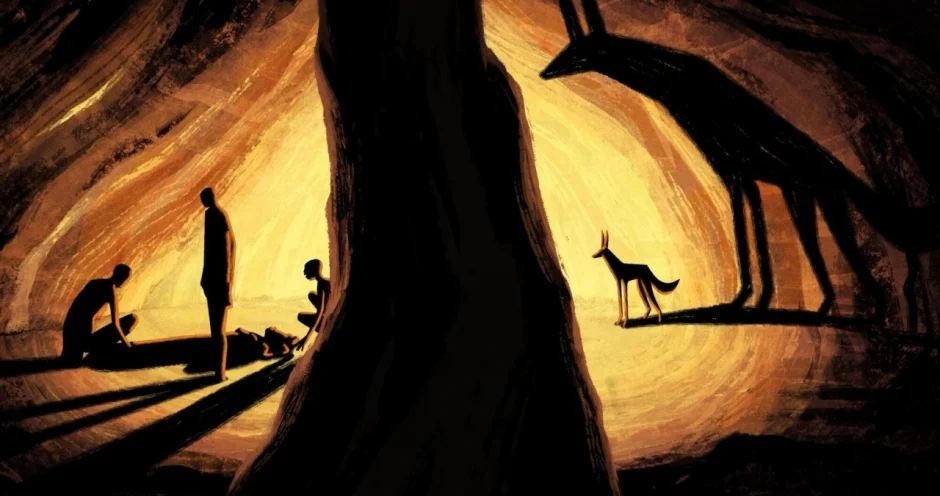
Figure 1. Nayola in the cave sequence with abstract figures and the canine presence. Nayola (2022), dir. José Miguel Ribeiro. Image source: Animation World Network. Available at: https://www.awn.com/animationworld/jos-miguel-ribeiro-talks-nayola-and-contagious-effects-war
The film then moves from ‘body in danger’ to ‘history as trace’. Blood traces become marks, and Nayola touches handprints on the walls of the cave. The handprint is one of the simplest and oldest visual assertions of human presence across time. The film suggests that war leaves marks in traces, stains, surfaces, and memory. Wells notes that animation can externalise inner states and compress complex experience into symbolic imagery rather than literal depiction (1998: 83). In Nayola, mark-making functions as a visual language of memory: violence is registered as a trace, and trace becomes a carrier of collective history.
Transmission becomes explicit through objects. The diary is not simply a plot device; it operates as a relay mechanism, shifting memory from private experience into something carried forward. The grandmother’s handling of the diary and the blood-stained photograph of Nayola insists that memory persists as material residue: paper, ink, stain, touch. As Susan Sontag cautions, ‘No “we” should be taken for granted when the subject is looking at other people’s pain’ (2003: 7). Nayola refuses an easy collective viewer-position. It pins war to intimate inheritances and ethical burdens carried forward through families, objects and voices.
The ending condenses these inheritances into one ambiguous figure. The masked figure crossing abandoned weapons is unreadable: Yara, Nayola, or both. The mask collapses the personal into the collective, shifting the film from biography to generational continuity. Under ‘Mona Ki Ngi Xica’, the figure becomes child, mother and survivor at once, moving through the debris of earlier conflicts. The song clarifies the film’s ending as inheritance rather than closure: it is not a triumphant national epic, but an account of what remains after the epic has failed, and what continues despite it.
References:
Agualusa, J.E. and Couto, M. (2019) ‘A Caixa Preta’, in O Terrorista Elegante e Outras Histórias. Alfragide: Quetzal Editores.
Animation World Network (2023) ‘José Miguel Ribeiro talks “Nayola” and the contagious effects of war’. Available at: https://www.awn.com/animationworld/jos-miguel-ribeiro-talks-nayola-and-contagious-effects-war (Accessed: 6 March 2026).
Bonga (1972) ‘Mona Ki Ngi Xica’ [song]. On Angola 72 [album]. Lusafrica. Available at: https://www.discogs.com/release/11653989-Bonga-Angola-72 (Accessed: 6 March 2026).
Caruth, C. (1996) ‘Introduction: The wound and the voice’, in Unclaimed Experience: Trauma, Narrative, and History. Baltimore, MD: Johns Hopkins University Press, pp. 1–12.
Chatelain, H. (1894) Folk-Tales of Angola: Fifty Tales, with Ki-Mbundu Text, Literal English Translation, Introduction, and Notes. Boston and New York: Houghton, Mifflin and Company. Available at: https://archive.org/download/folktalesofangol00chat/folktalesofangol00chat.pdf (Accessed: 6 March 2026).
Hirsch, M. (2008) ‘The generation of postmemory’, Poetics Today, 29(1), pp. 103–128. doi:10.1215/03335372-2007-019.
Kananoja, K. (2012) Central African Identities and Religiosity in Colonial Minas Gerais [PhD thesis]. Åbo Akademi University. Available at: https://www.doria.fi/bitstream/handle/10024/76664/kananoja_kalle.pdf (Accessed: 6 March 2026).
Miller, J.C. (1976) Kings and Kinsmen: Early Mbundu States in Angola. Oxford: Clarendon Press. Available at: https://www.scribd.com/document/601813785/ (Accessed: 6 March 2026).
Nayola (2022) Directed by J.M. Ribeiro [Film]. Portugal/Belgium/France/Netherlands: Praça Filmes; S.O.I.L. Productions; JPL Films; il Luster; Luna Blue Film.
Sontag, S. (2003) Regarding the Pain of Others. New York: Farrar, Straus and Giroux.
Wells, P. (1998) Understanding Animation. London: Routledge.
Dr. Myria Christophini is a Cypriot and Scottish award-winning artist and animation scholar. Her work spans animation, drawing, painting, and moving image, with an interest in visual storytelling and socially engaged practice. She has held academic posts at Xi’an Jiaotong–Liverpool University in China and at the University of Edinburgh/Edinburgh College of Art, and her work has been presented internationally through publications, screenings, and exhibitions.