
African animation scholars have discussed the role of formal art institutions in producing auteurs like Moustapha Alassane, Jean-Michel Kibushi, and Ebele Okoye (Callus 2018, Sawadogo 2019). In this piece, I propose that the African animation studio is a creative and learning center, a workshop that produces animation as well as animators. While individuals can take advantage of paid or free courses to become certified animators or VFX artists, building creative portfolios, and servicing clients through the gig economy, the animation studio provides a space for situated learning, mentorship, and industry connections. Several animators learned the art as autodidacts, and a few more earned formal degrees locally and abroad. Yet various institutions, including the studio, have ‘produced’ the Kenyan, Nigerian, Egyptian – the “African” – animator.
Early efforts at large-scale animation education across the continent targeted enthusiasts who were then trained by a handful of established independent animators. Initiatives like UNESCO’s Africa Animated! project (2004/2005) co-existed with the pedagogical objectives of Studio Malembe Maa, the first local animation studio in DRC, founded in 1989 by Jean-Michel Kibushi. A product of the National Institute of Arts (Kinshasa), Kibushi is renowned for his oeuvre, but the impact of Malembe Maa is worth highlighting. When Kibushi founded the studio, a priority was to fill a gap in narrative representation. With limited available expertise, however, the task soon shifted to animation education. “My struggle is to train artists in the region so that we can tell our stories and share them with the rest of the world,” he told Paula Callus in an interview (in Case, online). From 2009 to 2013, he ran the Afriqu’Anim’Action workshops “with the expectation that graduates of Studio Malembe Maa will then transmit their expertise to other Africans” (Chirol 2017). Participants of the workshop would create some of the animated shorts in the 2016 anthology L’Animation Indépendante Africaine: Volume 2. Essentially, accounts of the evolution of African animation must consider how pioneers and studios have led animation education locally and regionally.
From “pitch it” sessions at pre-festival workshops in Nigeria, Kenya, and Madagascar, where practitioners learn to pitch stories to buyers, investors, and distributors at international venues like Annecy’s Mifa, to themed programs like Triggerfish’s Story Lab Initiative and the Creator Labs aimed at closing the gender gap in African animation, animation studios have remained key institutional agents driving the development of the art, enterprise, and knowledge of animation in Africa. While they are only recently proliferating across the continent, studios provide continual artistic education and industry pathways for animators- and artists-in-training in a nation like Nigeria, where formal animation education is rare. Indeed, government-funded universities and technical colleges furnish courses in visual arts, painting, illustration, and digital media and film art, although these schools are hardly invested in specialized and certified training in animation. Because animation harnesses transmedia skills (sculpture, photography, and painting), exposure to artisanal, technical, and digital training in these formal institutions is invaluable for students seeking a career in animation, visual effects, motion graphics, and digital illustration. Graduates from those schools may seek practical training and full-time employment in major studios, many of which always need new hands. Along with other trainees, they work under the supervision of in-house artists who may not have had any formal training in their own formative process. In recent years, more Nigerian animation houses have largely adopted the train-to-retain model, where the establishment administers training as an investment in entry- or mid-level artists who may be novices to animation principles and techniques.
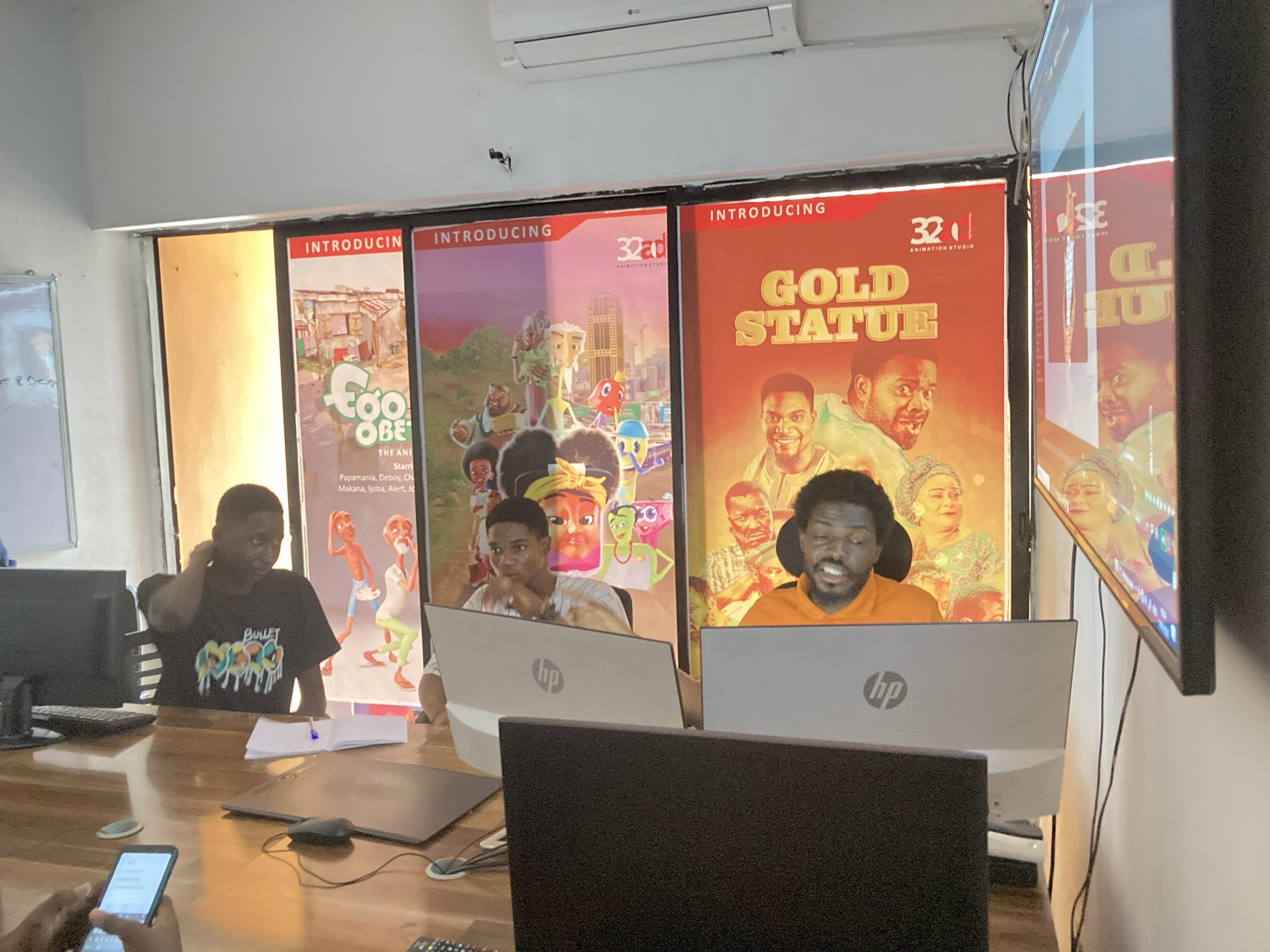
Figre. 1. Adebisi Adetayo of 32ad Studios with students of his art academy. Photo: author
Adebisi Adetayo’s 32ad Studios (Lagos) is a 3D computer animation academy and production studio that has used the train-to-retain model to produce Nigeria’s first successful animated feature, Lady Buckit and the Motley Mopsters, which was completed during the COVID pandemic. I met a young female animator who joined the studio as an office assistant but soon developed an interest in animation and has since become an in-house modeler and costume designer following her previous experience learning fashion design. Studies like 32ad combine creative practice with animation curriculum.
That pedagogy extends to other styles like stop-motion animation. Pioneers like Kibushi and Alassane have worked in the style. South Africa’s Triggerfish has its foundations in stop-motion. In Nigeria, animators like Esther Kemi Gbadamosi are leading the charge in stop-motion practice. Through the Radioxity Media Stop-Motion Academy, Gbadamosi is partnering with Oregon-based ShadowMachine to organize a symposium and training event where local talents in Lagos learn from stop-motion experts like Melanie Coombs, Robert Desue, Rachelle Lambden, and Brian Hansen. The program will feature practical sessions for students of Yaba College of Technology, a renowned government-funded technical school, and Pan-Atlantic University, a private institution offering courses in computer animation, VFX, motion graphics, and game design through its School of Media and Communication. Across the continent, animation executives and practitioners are taking initiatives to create pathways for producing talents that can service the emerging industry.
Uncertainties associated with contract hires and temporary staffing have prompted studios to take proactive measures, including assuming responsibility for animation education. Studios incentivize trainees through remuneration, opportunity for story credit, and/or integration into the workflow and studio organizational structure. These animation houses regularly organize free or for-a-fee summer bootcamps to train and potentially attract new talent that may join their personnel. Ultimately, these efforts are geared towards turning out skilled animators who can diversify the talent pool in the industry. As studios attract more local and international jobs and develop IPs, they require a structured creative team for seamless workflow and strategic market positioning.
Recent creative partnerships that led to major animation series like Kizazi Moto, Iwaju, and Iyanu raise questions about African studio production capacity. They highlight the efforts of Africa-based studios and practitioners who have worked to increase local talent through creativity and education. Investment in animation infrastructure should prioritize animation studios and, by extension, animation education. Another look at Fig. 1 above suggests how the studio can be a site for the recovery of knowledge on African animation productions. Observe how the sliding doors behind Adebisi and his students function as effective panels on which the studio curates and displays productions they have worked on or produced. In the absence of established digital archives on African animation, we may look to the animation studio as a physical repository archiving creative, collaborative, and pedagogic knowledge in the emerging broader animation landscape.
References:
Callus, Paula. (2018, July 30). Animating African History: Digital and Visual Trends. Oxford Research Encyclopedia of African History. Retrieved 31 Jan. 2026, from https://oxfordre.com/africanhistory/view/10.1093/acrefore/9780190277734.001.0001/acrefore-9780190277734-e-337.
Case, Alijah. Animating the DRC: Interview with Congolese Animator Jean-Michel Kibushi. https://www.der.org/animating-the-drc-interview-with-congolese-animator-jean-michel-kibushi/
Chirol, Marie-Magdaleine. (2017). Studio Malembe Maa. L’Animation Indépendante Africaine: Volume 2. 2016. 87 minutes. French, with English and Dutch subtitles. France. Les Films du Paradoxe. African Studies Review, 60(1), 237–239. doi:10.1017/asr.2017.36
Sawadogo, Boukary (2019). African Film Studies: An Introduction.
The Evolution of Kenya’s Animation Landscape. Creative Economies in Africa. YouTube, August 6, 2025, https://youtu.be/q1UnNCLYUeQ.
Michael Oshindoro is an Assistant Professor of Africana Studies at Bowdoin College. His research focuses on the intersection of live-action cinema and animation and VFX with broader interests in African visual and media studies and African art history. His writings have appeared in Journal of African Literature Association, Brittle Paper, Africa is a Country, and Fantasy/Animation.
Wow, a true review of the African animation landscape. I sincerely desire the government across Africa would be more deliberately involved in seeing growth within the animation and visual effects space