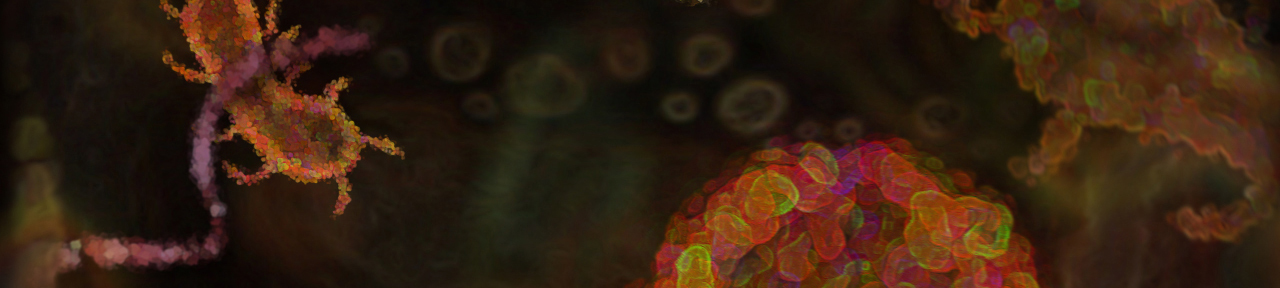
I am performative researcher, theorising through what Brad Haseman calls “enthusiasm of practice” (Haseman, 2006) rather than a premeditated research question. In performative research the practice itself is primary; the research results may embody knowledge which might not be adequately communicated by verbal means. I started my career as a fine artist and found my way to animation in 1999. Nothing much was happening animation-wise in South Africa at the time, despite the meteoric rise of William Kentridge in the early 1990’s. Primarily a service industry (Bendazzi, 2016: 305), South African animation started developing notably during the first decade of the 21st century. I was one of a handful of independent artists creating original local content, trying to establish an independent industry alongside the emerging commercial one. In 2009 I made animated clips for a poetry-based theatre production, thus discovering poetry-film.
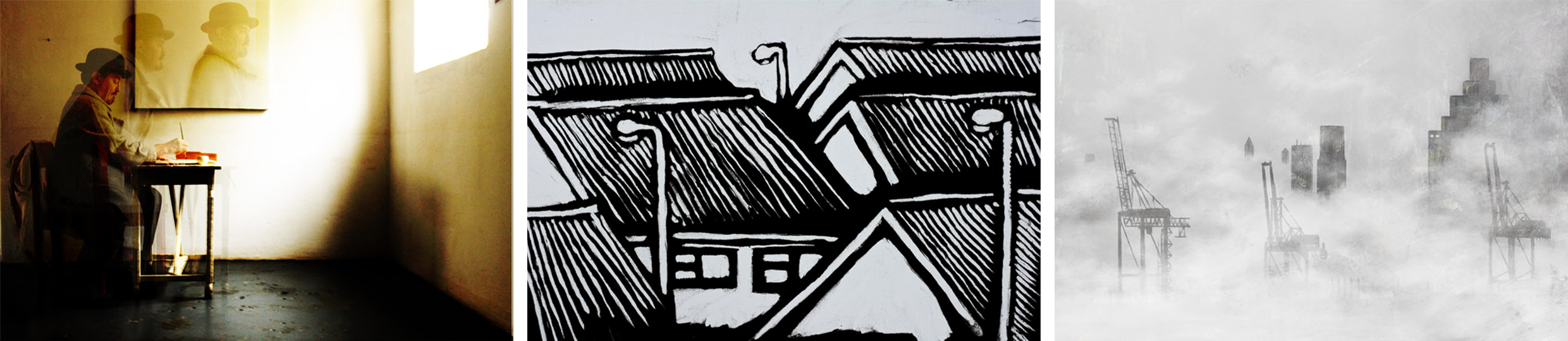
Figure 1. The project included work in a variety of animation techniques and styles. From left to right stills from the work of Diek Grobler, Naomi van Niekerk and Jac Hamman.
From 2013 to 2016 I curated a project called Filmverse (D. Grobler, 2016) which saw the creation of 24 Animated poetry films in my native Afrikaans language. The concept of a poetry-focused animation project is not unique: The Black Ceiling project in Estonia, and Dichtvorm (Huygens, 2007) in the Netherlands are examples of similar projects. What sets this project apart is the absence of a culture of narrative animation production in Afrikaans prior to 2000 and the complicated socio-political history of the language itself. The project created a notable number of films in a short time in a language which had no history or tradition in the medium.
A brief background to the language
The complexity of the South African social landscape is hard to grasp for somebody not living in it. The country has 11 official languages and many more distinct cultural groupings. Afrikaans is one of the eleven and its social situation in itself complex: Emerging from among the indigenous cultures and the slaves in the kitchens of the colony, the language blended seafarer variants of Malay, Portuguese, Indonesian, the indigenous Khoekhoe and San languages and 17 century Dutch of the colonial masters (Willemse 2017:sp). In the 20th century Afrikaans became closely associated with the infamous political regime of Apartheid. Aided by its role as official language of the government, it grew during the 20th century to an extensive language with universities and an impressive body of literature. Today it is the third most spoken language in South Africa, with roughly 7 million Mother-tongue speakers in the country.
Over the past two decades the language has been systematically reclaimed from its negative, predominantly white association through academic research and cultural activity. This refocussing of the language is driven by a younger generation of Afrikaans artists, writers and musicians of all ethnicities.
The Filmverse project aimed to align with this refocussing by increasing the visibility and exposure of poetry. In the treatment of poems from different eras in the history of Afrikaans, we removed race-based barriers by re-imagining classical poems. We created educational material and educational methods. The project also aimed to disseminate the language to previously unexplored audiences via the international festival circuit.
The politics of animated poetry
Of the various terms used to refer to variants of cinematic poetry, I prefer the term ‘Animated poetry’ as it highlights the intentionality of the animation process. Literary scholars, Riffaterre, (1980), Wolosky, (2001), amongst others, accentuate the intentionality of language in poetry; every word is considered and placed in a specific position within a text in relation to other words. Animation, created frame by frame, has the same intentionality. Animated poetry is a form of animated film in which transmediation (Suhor, 1984)
occurs between literary text and animated imagery, causing an interplay between literary and animatic meaning-making. Within that interplay, opportunity arises for shifting the focus in existing literary narratives, with the possibility to align it with contemporary socio-political values.
The inherent experimental nature of animated poetry allows for exploratory visual approaches, which lent it well to a project with diverse participants. The age of the participating artists varied from 25 to 60, and skill levels ranged from skilled, trained animators to visual artist which have never worked with animation before: painters, illustrators, ceramicists and puppeteers. Rudimentary training was provided in the form of a three-day workshop in which the basic principle of animation was taught and explored. The participants were then provided with a long list of poems from which they could select a text and pitch a project a month later. After selection, my mentoring would continue through personal communication and studio visits. The animation styles and techniques were varied – from puppet and object animation to hand-drawn films with a cartoon aesthetic. Digital animation was discouraged, primarily due to a lack of skill and training, and the bulk of the films were hand made through a traditional production approach.
The 24 films produced in the project was widely used in South Africa as educational tools on both secondary and tertiary levels. The project prompted two PhD studies, so far – my own (G. D. Grobler, 2021) and an Afrikaans language PhD on Multi-modal metaphors in poetry-film (Van der Merwe, 2022).
Films from the project reached international audiences at animation- and poetry festivals, were featured at the Weimar Poetry-film Award and Zebra Poetry-film Festivals in 2015 and 2017. Naomi van Niekerk received the Jean-Luc Xiberras Award for best First Film at Annecy for An ordinary blue Monday in 2015. A fair percentage of the animators involved in the project are pursuing careers in animation and still creates animated poetry, also in Afrikaans. Time will tell if the potential of the medium of animated poetry to expand the language is acknowledged by the powers that be: Those powers which through scant funding determines which expressive forms of a marginalised culture and language prevails and which, out of necessity, turns to English.
Link to films in the project: https://atkv.org.za/neem-deel/taalprojekte/filmverse/
References:
Bendazzi, G. (2016). Animation: a world history, vol 3. CRC Press.
Bradford, R. (2010). Poetry: The ultimate guide. Palgrave Macmillan.
Grobler, D. (2016). Filmverse 2 (p. 12) [Video recording]. ATKV.
Grobler, G. D. (2021). Narrative strategies in the creation of animated poetry-film. [Thesis, University of South Africa]. http://hdl.handle.net/10500/27666
Haseman, B. (2006). A manifesto for performative research. Media International Australia, 118(1), 98–106.
Huygens, I. (2007, October 1). Dicht/Vorm: animation meets poetry. Shortfilm.De.
Riffaterre, M. (1980). Semiotics of poetry Indiana University Press. Indiana University Press.
Suhor, C. (1984). Towards a Semiotics-based Curriculum. Journal of Curriculum Studies, 16, 247–257.
Van der Merwe, L. J. (2022). ’n Kognitief-semiotiese verkenning van multimodale metafore in Filmverse I en II. University of Pretoria.
Wolosky, S. (2001). The Art of Poetry. Oxford University Press.
Diek Grobler is a practicing film maker, researcher and MA supervisor at the Open Window University, Zambia. He holds a PhD in Art from the University of South Africa; thesis topic – Narrative strategies in animated poetry-film. Recent publications include: Improvisation as narrative strategy in auteur animation. Animation Art in Africa and Arab World Conference proceedings. Democratic Arab Center for Strategic and Political Studies, Berlin. ISBN: 978-3-68929-107-5; Translation as Metamorphosis in the Animated Poetry-film. Critical Arts. Taylor & Francis Group. DOI: 10.1080/02560046.2023.2262555; Animation in the art gallery. Catalogue essay for Another Time, Another Place exhibition catalogue Volume 2, an exhibition of University of Pretoria alumni from the decade before South African democracy (1984 – 1994). ISBN 978-0-620-97304-5 November 2021. Diek Grobler’s animation is hand-crafted, and his techniques include hand drawn animation, kinestatic animation, digital cut-out and pinscreen animation. Diek Grobler lives and works in Pretoria, South Africa. https://orcid.org/0009-0005-9484-569X.