
Vivienne Barry’s Como alitas del chincol (2002) is an animated documentary that dramatizes the contradictory roles of the arpilleristas as women engaged in both domestic craft and political subversion. A tribute to the quilters who survived and documented Pinochet’s dictatorship in Chile, Barry’s film does not present these textile objects as mere historical artifacts but animates them in order to demonstrate how these materials, so often relegated to the feminine and decorative, become powerful and subversive testimony (Furniss 2017, pp. 415–16).
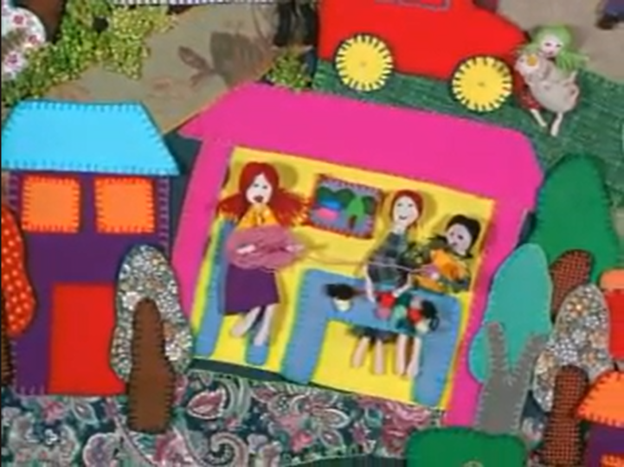
Figure 1. Women rolling yarn into a ball. Como alitas del Chincol, 2002 (4:07)
Como alitas del chincol can be read as an expression of what Jennifer Lynde Barker calls “fuzzy modernism”; a textile-based mode of stop-motion animation in which soft materials are used self-consciously to rethink the relation between objects, bodies, and historical reality (Barker 2021, p. 4). An aesthetic of animation characterized by softness, texture, ambiguity, and metamorphosis, fabric and string are not limited to mundane materiality. Rather, they are free to establish a different relationship with reality. The liveliness of patches and dolls points to the instability of the world and its potential futures (Ibid.). Instead of showing a documentary-style reconstruction of Pinochet’s dictatorship, Barry presents the country through the very materials that have been most associated with women’s domestic labor: fabric, felt, dolls, and photographs.
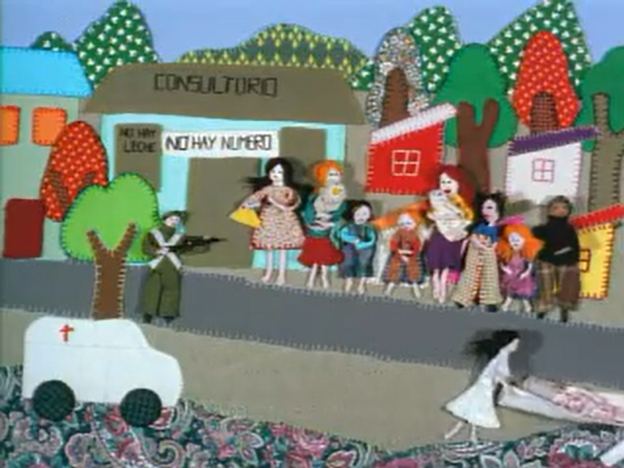
Figure 2. People wait in line outside a clinic as a soldier watches them. A sign reads “no hay leche.” (“No milk,” 4:28)
This quilted world is deliberately brilliant and colorful, contrasting with the harsh reality of its subject matter. In one sequence, the sun rises as the camera pulls back to reveal a city laid out in a series of patches, with no attempt at conventional perspective. Domesticity is on display as women roll yarn, wash clothing, hang laundry, care for children, and serve food to their community. Yet drab-colored soldiers are ever present, standing outside buildings like the Denmark Embassy (3:46), or policing a line of people as they stand outside a clinic (4:28).
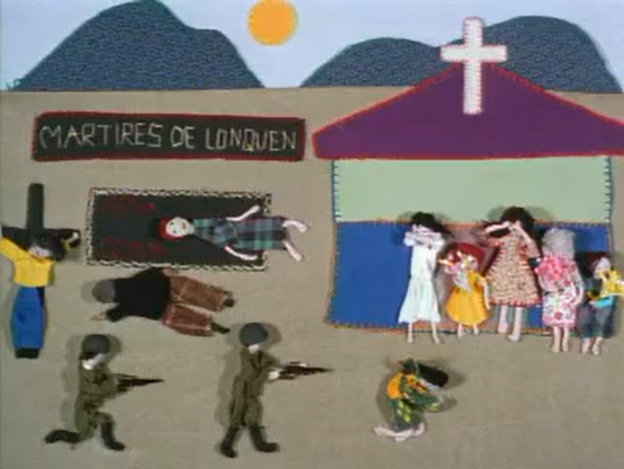
Figure 3. A couple lie dead on the street while a pair of soldiers prepare to execute a third woman. The scene becomes unbearable; a church crowd covers their eyes. Como alitas del Chincol, 2002 (5:05)
The most disturbing scene occurs outside a church. Bodies litter the street as soldiers execute a woman (4:57). A sign reads “Martires de Lonquén,” (martyrs of Lonquén) referring to a small town in which twenty-one people went missing in 1973, their bodies remaining undiscovered until 1979 (Moya-Raggio 1984, p.282 fn.4). Here, memory and reality interweave. While the bodies went missing for years, the death of their doll facsimiles are witnessed both by the audience and the onlookers in the church. Bright, patterned, and cheerful fabric conveys hunger, terror, and death. Scenes of state violence are interspersed with quotidian domesticity, in which women take on the mundane tasks of the everyday, sustaining the lives of themselves and those in their community in the process. Instead of tempering the horrors of the dictatorship, Barry’s handmade “cozy” aesthetic makes them all the more disturbing because it forces the viewer to recognize how state violence penetrated those quotidian spaces, and how such mundane acts become methods of resisting oppression.
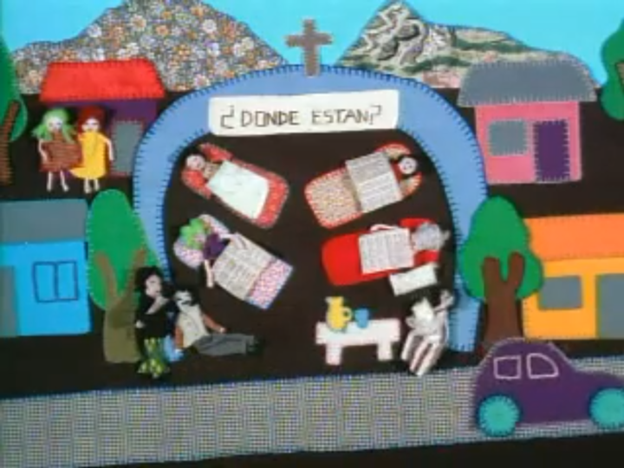
Figure 4. A group of people find shelter in a church. Como alitas del Chincol, 2002 (2:48)
This is also exactly how the arpilleras worked: burlap-backed, appliquéd, embroidered wall hangings were made from colorful scraps of fabric and inexpensive thread. Before the dictatorship, this kind of fiber art often depicted pastoral scenes of daily life (McCracken as cited by Ortiz-Vilarelle 2022, p.29). Under Pinochet, however, these quilts became a method of subverting censorship and disseminating visual testimony of resistance (Ibid.). Women appliquéd photographs of the missing, used scraps cut from the clothing of lost loved ones, and embroidered messages into their works to record important names and dates. In this regard, Barry’s use of fabric and dolls is very much part of this tradition. When a sign hanging from a church reads “¿Dónde están?” (Where are they?), the film makes visible the arpillera’s function as a public memorial to the disappeared.
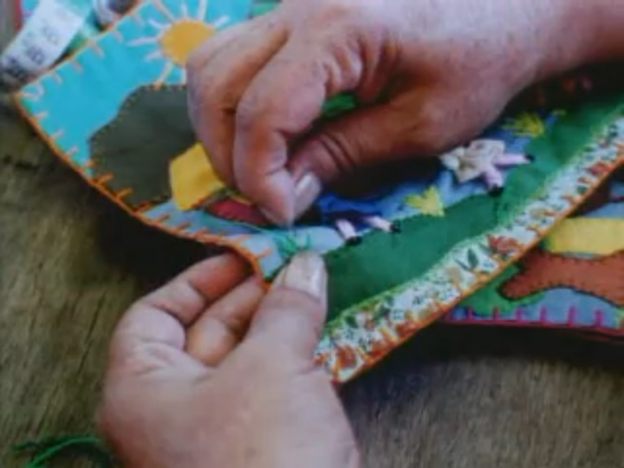
Figure 5. Photo of a woman’s hands sewing a colorful scene onto a patch of fabric. Como alitas del Chincol, 2002 (7:09)
Handmade animation invites viewers to recognize the labor and construction behind the animated image (Ruddell and Ward, 2019, p.2). Barry extends this idea beyond individual authorship. Later in the film, the scenes of fabric give way to photographs of women’s hands, before finally revealing the faces of the women themselves as they craft these arpilleras (7:09). From the animated materials, to hands, to women’s faces, this development shifts the notion of “the hand of the artist” to a politics of feminist collectivity. The film insists that history has not simply been written by singular authors from official institutions but collectively stitched by women whose labor was relegated to mere domestic trifles.
That invisibility is part of the contradiction Barry dramatizes. Women’s craft has often been devalued because it is associated with decoration, comfort, and the home. Women’s animation and domestic craft have frequently been dismissed as less serious than supposedly more political or national topics (Barker 2021, p.1). Discussions of craft have long been entangled with problematic assumptions about gender and with the patriarchal marginalization of women’s creative labor (Ruddell and Ward 2019, p.6). Yet Barry’s film highlights how the very qualities used to diminish women’s work make the documentation of state horror possible.
The dictatorship’s own response confirms the political danger of this work. In Barry’s film, newspapers describe the tapestries as subversive, seditious, and anti-Chilean (5:23). These headlines reveal that the state did not perceive the arpilleras as harmless craft once their testimony began to circulate. Arpilleras allowed women to use domesticity to position themselves as social and political actors in the resistance; their underestimated voices of dissent suddenly became a threat to Pinochet’s hegemony (Ortiz-Vilarelle 2022, p.47). Softness transforms into political force. While other artforms were censored or destroyed, the arpilleras could move through channels unavailable to more direct forms of protest. But because they testified to disappearance, hunger, and repression, they also became objects of censorship and policing.
Como alitas del chincol therefore revises reality by refusing the terms through which dictatorship defines what counts as history. Barry does not provide us with an authoritative account of Pinochet’s Chile. She gives us scraps, dolls, photographs, songs and hands holding needles and thread. In doing so, she shows that the handmade and the cozy can articulate horror precisely because they belong to the intimate spaces where oppression is a lived experience. If fuzzy modernism reveals the “metamorphic potential of the world of objects,” Barry politicizes that potential, showing how everyday textiles can be transformed from signs of domestic labor into fragile but persistent instruments of hope under fascism (Barker 2021, p. 4). The film’s feminist force lies in this contradiction; the materials of care become materials of resistance.
References
Barker, Jennifer Lynde. “Crafting Animation: Hermína Týrlová’s Fuzzy Modernism.” MAI: Feminism & Visual Culture, 13 Dec. 2021, www.maifeminism.com/crafting-animation-hermina-tyrlova-fuzzy-modernism.
Vivienne Barry. “Como alitas del chincol de Vivienne Barry.” YouTube, 26 July 2013, ">www.youtube.com/watch?v=CNKeLhTyiWQ.
Boeckenhoff, Katharina, and Caroline Ruddell. “Lotte Reiniger: The Crafty Animator and Cultural Value.” The Crafty Animator : Handmade, Craft-based Animation and Cultural Value, edited by Paul Ward and Caroline Ruddell, Palgrave Macmillan, 2019, pp. 75–98.
Furniss, Maureen. Animation: The Global History. Thames and Hudson, 2017, pp. 415-416
Moya-Raggio, Eliana. “‘Arpilleras’: Chilean Culture of Resistance.” Feminist Studies, vol. 10.2, 1984, pp. 277–90.
Ortiz-Vilarelle, Lisa. “Textile Auto/Biography: Protest, Testimony, and Solidarity in the Chilean Arpillerista Movement.” Biography, vol. 45, no. 1, Jan. 2022, pp. 28–49. https://doi.org/10.1353/bio.2022.0016.
Ruddell, Caroline, and Paul Ward. “Introduction.” The Crafty Animator : Handmade, Craft-based Animation and Cultural Value, edited by Paul Ward and Caroline Ruddell, Palgrave Macmillan, 2019, pp. 1–16.
Dr. Colin Wheeler researches creative discourse in media industries, with a focus on animation studios in the United States. A passionate creator and critic of animated media, he produces short experimental films that incorporate animation, puppetry, and live action. After completing his MFA in Animation at the Savannah College of Art and Design, he went on to earn a doctorate in Communication at Georgia State University. This background allows him to explore the industry as both a practitioner and a scholar, using his on-the-ground perspective to inform broader theories on production cultures and the creative class. When he is not conducting research, he teaches storyboarding and animation history at Kennesaw State University.